Elías Jaua, Juan Barreto, and María Alejandra Díaz criticized the military rapprochement with Washington and raised concerns about its constitutional legitimacy, terms, and political consequences following the events of January 3.
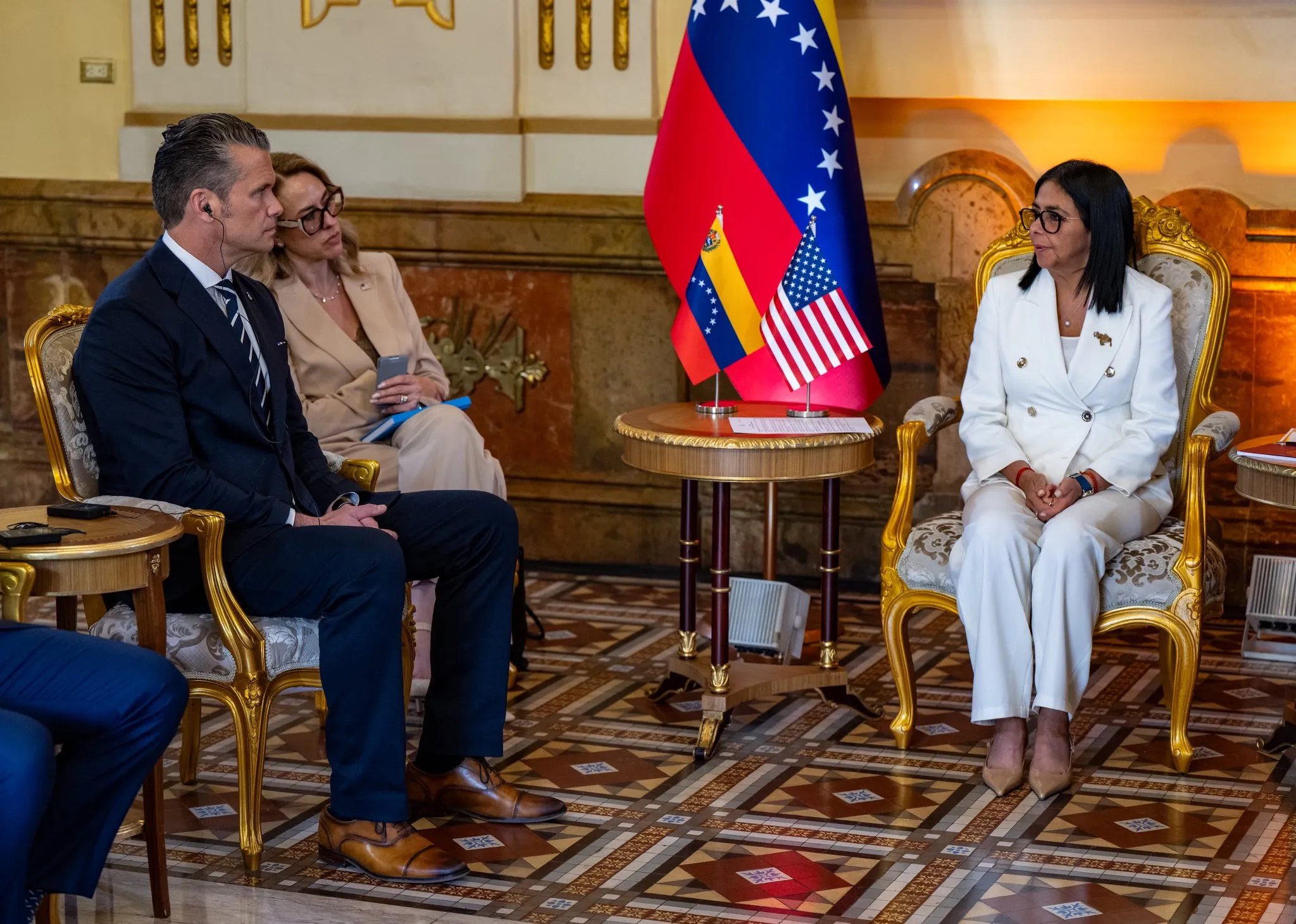
The Daily Journal – Political leaders and figures historically associated with Chavismo questioned the agreement to resume technical and military cooperation between Venezuela and the United States, announced during U.S. Secretary of War Pete Hegseth’s visit to Caracas, and criticized the Delcy Rodríguez government’s political shift toward Washington.
Former Executive Vice President Elías Jaua questioned whether the acting president has the constitutional authority to make decisions concerning military policy, public finances, and international relations.
“Under Venezuela’s Constitution, the executive vice president does not exercise the functions of head of state. Therefore, while serving as acting president, they lack authority over military policy, public finances, and international relations, which fall exclusively within the powers of the head of state,” Jaua stated in a message shared on social media.
Jaua argued that no one has the right to pursue policies that, in his view, undermine “national security, national assets, independence, and dignity.” He also called for a political, civic, democratic, and grassroots movement to restore respect for the Constitution.
Former Caracas Metropolitan Mayor Juan Barreto, meanwhile, questioned the political implications of the rapprochement between the two governments and raised questions about Nicolás Maduro’s isolation.
“What will PSUV leaders say now? Has Maduro been left alone? Have they abandoned him to his fate? He is Trump’s war trophy,” Barreto wrote, comparing the situation to a hunter displaying the mounted head of his prey above a fireplace.
Lawyer and former constituent assembly member María Alejandra Díaz focused her criticism on what she described as a contradiction: establishing military cooperation mechanisms with the United States after the January 3 operation.
“At what point did we go from denouncing U.S. military interference to establishing military cooperation with those who carried out the January 3 operation? At what point did defending sovereignty cease to be a nonnegotiable principle and become a bargaining chip for political survival?” she asked.
Díaz clarified that her objections do not concern restoring diplomatic relations or Venezuela’s right to maintain commercial and political ties with any country. However, she warned that pragmatism must not turn into “capitulation.”
“Restoring relations between sovereign states is one thing. Accepting military cooperation mechanisms with a power that has just violated the Republic’s territory, institutions, and capacity for self-determination is quite another, especially without a public explanation of the terms, limits, and guarantees of those agreements,” she stated.
Resumption of military cooperation
The criticism follows Defense Minister Gustavo González López’s announcement of progress toward restoring technical and military cooperation with the United States “to its previous levels” as part of a new phase in bilateral relations.
According to the official statement, the agenda includes education, training, technical exchanges, technological modernization, and improvements to military capabilities and equipment. The minister said these activities would follow the principles of mutual respect, sovereignty, and reciprocity while complying with Venezuela’s legal framework.
González López maintained that the cooperation mechanisms would preserve the leadership, command structure, and authority of the Bolivarian National Armed Forces.
The announcement marks a shift in military relations between the two countries, which had suspended cooperation in 2005 during Hugo Chávez’s presidency.