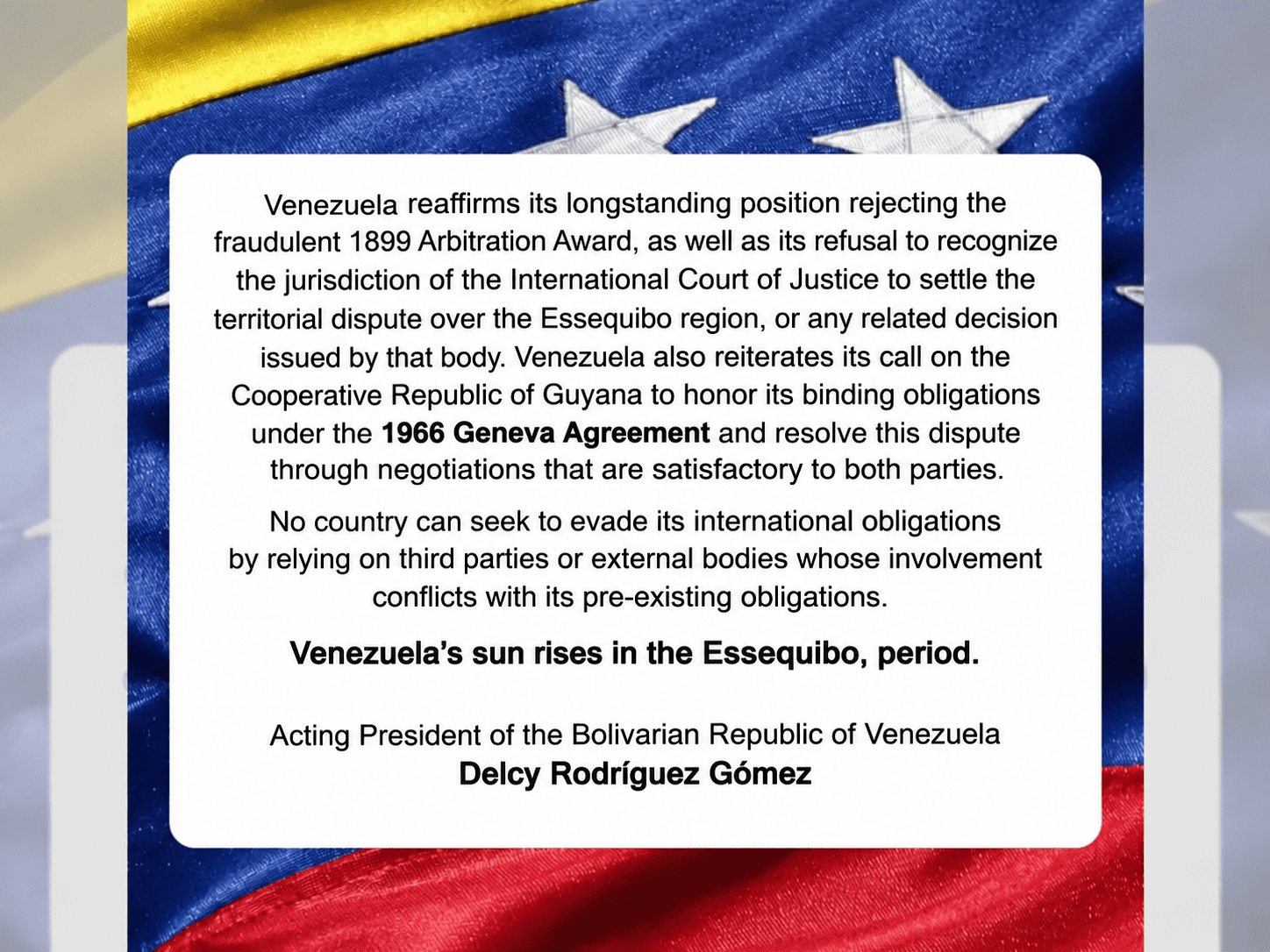
The Daily Journal – Venezuela’s acting President Delcy Rodríguez reaffirmed on Friday the country’s rejection of the 1899 Paris Arbitration Award and its refusal to recognize the International Court of Justice’s (ICJ) jurisdiction over the Essequibo region. Her statement came a day after the United States reiterated its support for the award, amid a diplomatic controversy over reports that a U.S. official had suggested Guyana cede part of the disputed territory to Venezuela.
In a statement shared through her Telegram channel, Rodríguez reiterated Venezuela’s “longstanding position rejecting the fraudulent 1899 arbitration award.” She also warned that Venezuela would not recognize any related ruling from the ICJ. Furthermore, she argued that no country can evade its international obligations by relying on third parties or external institutions.
Although the statement did not explicitly mention Washington, Rodríguez urged Guyana to comply with the 1966 Geneva Agreement and resolve the dispute through dialogue and negotiations that satisfy both parties. She concluded with the slogan, “Venezuela’s sun rises over the Essequibo, period.”
The proposal that sparked the controversy
On Thursday, Reuters reported that an official in Donald Trump’s administration had suggested that Guyana consider ceding part of the Essequibo region to Venezuela. According to the report, Jeremy Lewin, then head of policy planning at the U.S. State Department, raised the proposal with Guyanese Foreign Minister Robert Persaud in September and offered to mediate potential negotiations. Lewin left his position in late October.
According to Reuters, a State Department spokesperson said the department receives various proposals every day but emphasized that the U.S. position on the border remains unchanged.
That same day, the U.S. Embassy in Georgetown stated that “the policy on the land boundary between the two countries has not changed.” It added that both countries must respect the arbitration award unless a competent legal body or the two parties establish a different boundary. In doing so, the embassy left open the possibility of a mutually agreed solution.
For its part, Guyana’s Foreign Ministry confirmed that officials had discussed the territorial dispute during a September meeting with U.S. representatives. The ministry said it had received assurances that “nothing has changed since then” and submitted formal objections to the State Department.
President Irfaan Ali stated that Washington respects Guyana’s territorial integrity and declared that “the ICJ ruling is something we will all have to accept, period.” When reporters asked whether Trump was pushing for a bilateral solution, Ali replied that the United States has “always supported our sovereignty and territorial integrity.”
What happens next?
The ICJ has been examining the case since 2018, and its final ruling remains pending. The court has not announced a date for its decision.
Venezuela had already warned that it would not comply with the ruling. During hearings in May, Rodríguez reiterated that position before the judges, describing the case as a “legal absurdity.”
It remains unclear whether Washington will further clarify its position regarding potential mediation.
According to Reuters, the suggestion came after Rodríguez sent Trump a letter in May requesting his mediation to facilitate direct talks with Guyana.
Historical background
The disputed territory covers approximately 160,000 square kilometers, representing more than two-thirds of the territory Guyana administers.
An arbitration tribunal issued the award in Paris on October 3, 1899, following a treaty between the United States (representing Venezuela) and the United Kingdom.
Guyana maintains that both sides accepted the award for more than 60 years, until Venezuela declared it null and void in 1962.
Caracas argues that the 1966 Geneva Agreement effectively superseded the arbitration award.
After negotiations reached a deadlock, United Nations Secretary-General António Guterres ended the mediation process in 2018.
Guyana subsequently brought the dispute before the ICJ, which ruled in 2020 that it had jurisdiction to examine the validity of the 1899 arbitration award.