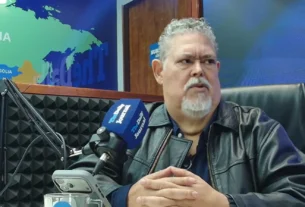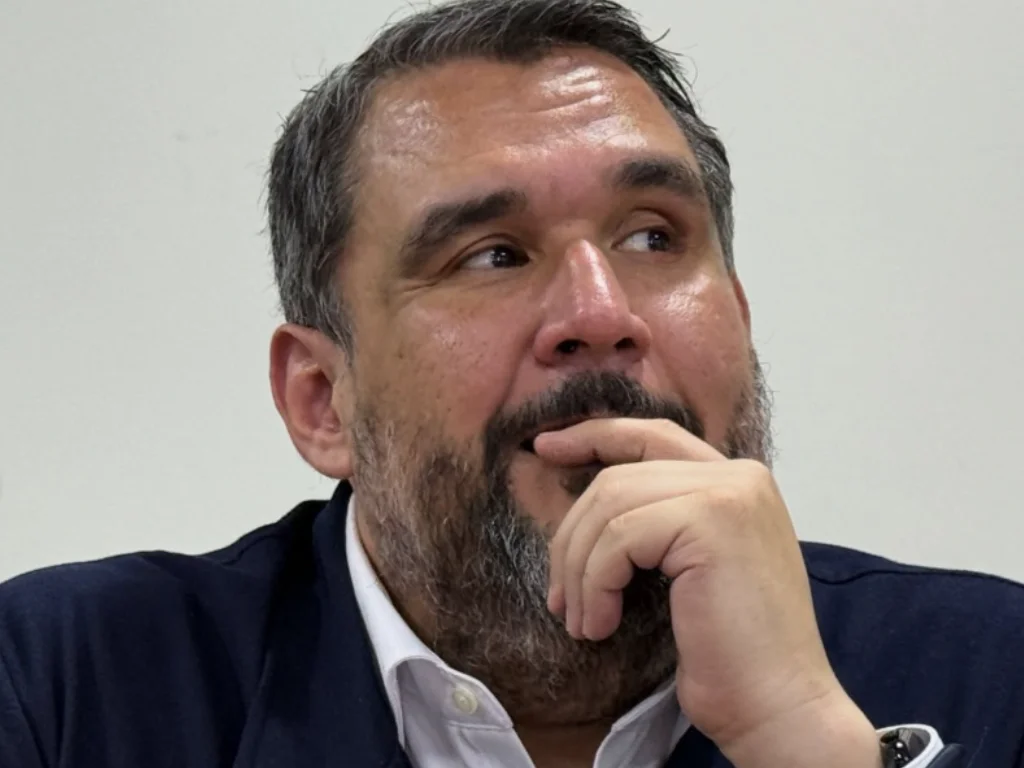
Juan Miguel Matheus, a member of the negotiating team, believes that overhauling the Supreme Court of Justice is a necessary step toward ensuring a lasting democratic transition. He also acknowledges that the United States has set the terms of the negotiations and that its energy and geopolitical interests shape the process.
By Neirlay Andrade
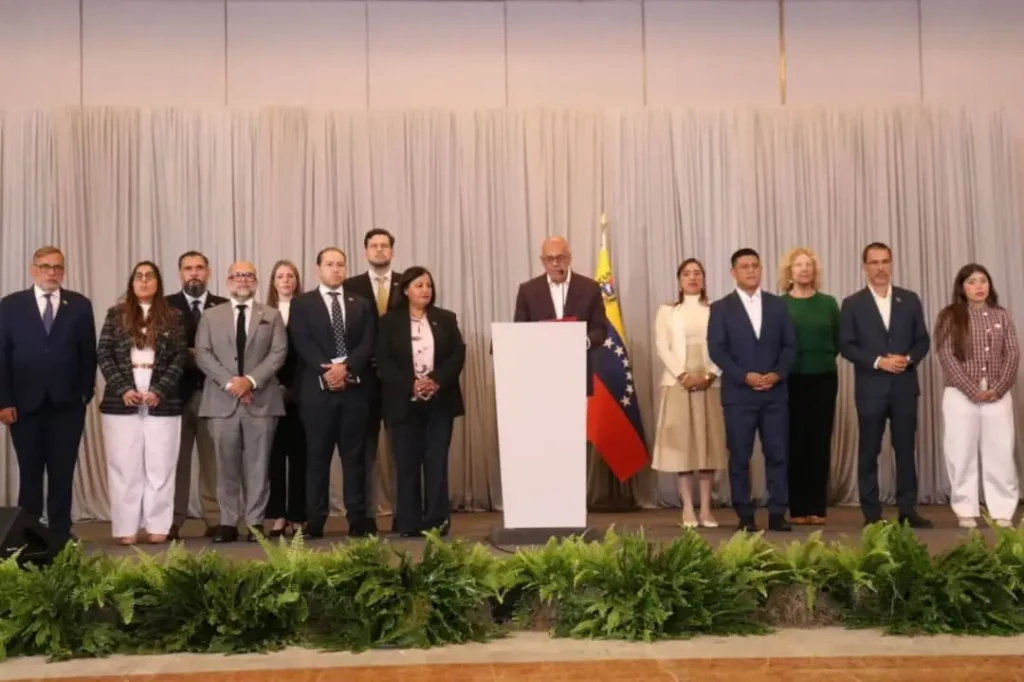
On October 22, the National Assembly announced the names of the 12 civil society representatives who will serve on the Judicial Nominations Committee, the body responsible for evaluating the credentials of candidates seeking appointments as justices of the Supreme Court of Justice (TSJ).
The announcement followed ongoing negotiations between the interim government and representatives of the 2015 National Assembly, through U.S.-led talks after the January 3 military operation that culminated in Nicolás Maduro’s capture and Delcy Rodríguez’s appointment as interim president.
Since the beginning of this period, which senior government officials have described as a “new political moment,” one of the public’s main demands has been presidential elections. The ruling party declared victory in the 2024 elections without publishing detailed voting results. Consequently, the electoral controversy remains part of the public debate, even as wages deteriorate and the national electricity system faces a severe crisis.
Nearly ten months have passed since the airstrikes on Caracas. Yet, the demand for a democratic transition remains a secondary priority within the three-phase plan that U.S. Secretary of State Marco Rubio presented in early January. Trump has also repeatedly stated that Venezuela is not yet ready to hold elections.
Against this backdrop of tension between public demands and the priority given to institutional reconstruction, Venezuelans are watching another attempt at negotiations between the ruling leadership, led by the Rodríguez siblings, and representatives of the 2015 National Assembly, led by Dinorah Figuera.
In this context, constitutional lawyer Juan Miguel Matheus, a member of the U.S.-sponsored negotiating team, delivered a lecture at Andrés Bello Catholic University (UCAB) on the same day Jorge Rodríguez announced the formation of the Judicial Nominations Committee. During his presentation, he explained why he believes reforming the justice system must serve as the starting point for the political transition.
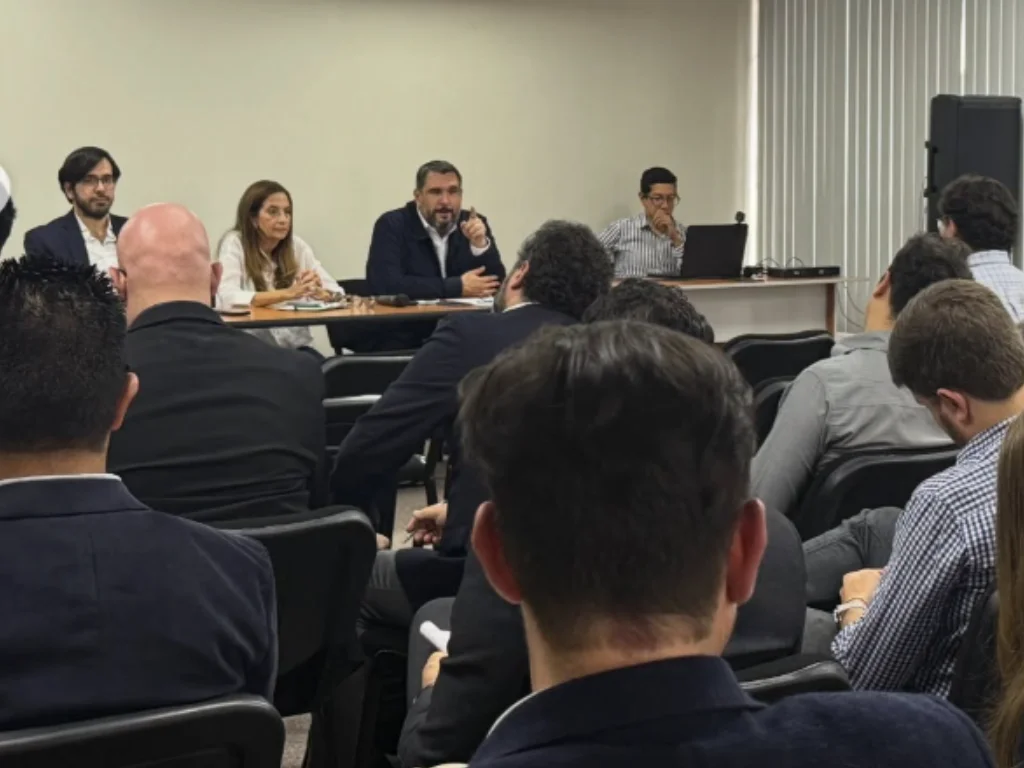
Photo: UCAB’s Center for Political and Government Studies (CEPyG)
Negotiations under U.S. leadership
According to Matheus, three developments shape Venezuela’s current political process: the January 3 military operation and Maduro’s capture; the earthquake that, in his view, increased the U.S. presence on Venezuelan territory; and the oil agreement between Caracas and Washington.
Based on these developments, he argued that Venezuela has become a geopolitical partner of the United States and that Washington’s interest extends beyond Trump’s Republican administration.
“Venezuela is beginning to become part of a bipartisan U.S. state policy, where it doesn’t matter whether the government is Republican or Democratic,” he stated.
In his view, Venezuela’s energy, economic, and geopolitical importance will sustain U.S. interest “for decades to come.”
“Someone asked me, ‘Is it possible that if the Democrats win the U.S. presidency, Maduro could return to Venezuela?’ And the answer is obvious: No. Nobody is going to get Maduro and Cilia Flores out of the United States,” he asserted.
Matheus explicitly described Washington’s role in the talks. He maintained that the United States has completely defined the framework of the negotiations that emerged after January 3, saying Washington “set the table, served the meal, chose the menu and established the technical framework” for talks between Delcy Rodríguez’s interim government and representatives of the 2015 National Assembly.
“Any Venezuelan who claims to have had any real influence over the terms of the negotiations is lying,” he declared.
His statement places Venezuelan participants in a subordinate position relative to U.S. leadership of the process. Nevertheless, the lawyer believes this circumstance does not invalidate the dialogue.
“Our role is simply to try to derive consequences that strengthen the rule of law and economic prosperity within the parameters established by the United States,” he added.
From overhauling the Supreme Court to transforming the justice system
The first formal round of talks began on August 6. Matheus explained that the initial discussions focused on renewing the TSJ’s Electoral Chamber. Still, an agreement reached one week later expanded the proposal to encompass a broader transformation of the justice system.
The plan included appointing the Supreme Court’s 32 principal justices and 32 alternate justices, along with reforms to auxiliary bodies such as the General Inspectorate of Courts and the National School of the Judiciary.
The composition of the Judicial Nominations Committee became one of the most contentious issues during the first round. Matheus noted disagreements over whether lawmakers should participate in the committee.
“They argued that it was natural, that it complied with constitutional orthodoxy, for the committee to include some lawmakers. We then brought out the Official Gazette and read Article 270 of the Constitution to them, which establishes that the Judicial Nominations Committee is an advisory body to the Judiciary and consists of representatives from different sectors of national society,” Matheus recalled.
The constitutional lawyer explained that the controversy stemmed from the publication of two different official gazettes containing the 1999 Constitution. When negotiators failed to reach an agreement on a committee composed exclusively of civil society representatives, a “typical transitional compensatory mechanism” emerged: the Credentials Verification Council for judicial candidates.
“We created the Verification Council to establish a mirror mechanism that would give the 2015 National Assembly decision-making control. Just as they have control over the Judicial Nominations Committee, we have control over the Verification Council,” he explained.
The council includes legal scholars Belén Ramírez Landaeta, Rogelio Pérez Perdomo, Bernardo Pulido Márquez, María Bernardoni de Govea, Silio César Sánchez Zerpa, Federico Sebastián Fuenmayor Gallo and Deyanira Nieves Bastidas.
According to Matheus, the mechanism helped break the deadlock and kept judicial reform on the agreed agenda.
A new Supreme Court by December 15
The application process begins on October 28. Civil society organizations are debating the need to make the evaluation criteria public so Venezuelans can understand how authorities will select the new justices.
Matheus estimated that the application period would last at least 15 business days. The committee would then conduct an initial selection, followed by a second review by the Citizen Branch of government and, finally, the appointment of the justices.
“With the understanding that the negotiating table is the governing body overseeing this entire process,” he clarified.
Based on that timetable, he said, “it is not irresponsible to suggest that we could have a new Supreme Court of Justice by approximately December 15.”
Distrust, dual nationality and salaries
Matheus identified several obstacles to completing the process. The first is widespread distrust among citizens and legal professionals, whom he described as experiencing “learned helplessness” regarding the prospects for institutional transformation.
He explained that this skepticism initially made it difficult to recruit individuals willing to serve on the Judicial Nominations Committee and could also discourage candidates from applying for judicial positions. Nevertheless, he said he was confident the process would attract enough applicants.
Another obstacle involves the constitutional prohibition preventing individuals with dual nationality from holding certain positions. Matheus argued that the transition must overcome this restriction.
He also addressed judicial compensation, noting that negotiators have reached a preliminary agreement to improve justices’ salaries. He defended the measure as essential: “First, because it is a matter of justice, but also because it is a sine qua non condition for combating corruption and the conditions that foster corruption.”
Ordinary courts: The next challenge
During his lecture, Matheus argued that reforms must extend to ordinary courts, “which cause the greatest harm to citizens’ rights, whether through corruption, undue delays in judicial proceedings, persecution or human rights violations.”
The lawyer expected negotiators to address this issue during an upcoming round of talks.
Why not call elections immediately?
The argument for judicial reform before elections represents one of the central positions of the 2015 National Assembly representatives.
“Everything we are doing to ensure the integrity of the system and transform the justice system aims to establish solid foundations for a democracy that can endure over time,” Matheus stated.
In his assessment, “the U.S. presence” and “Marco Rubio’s personal commitment” distinguish these negotiations from previous efforts.
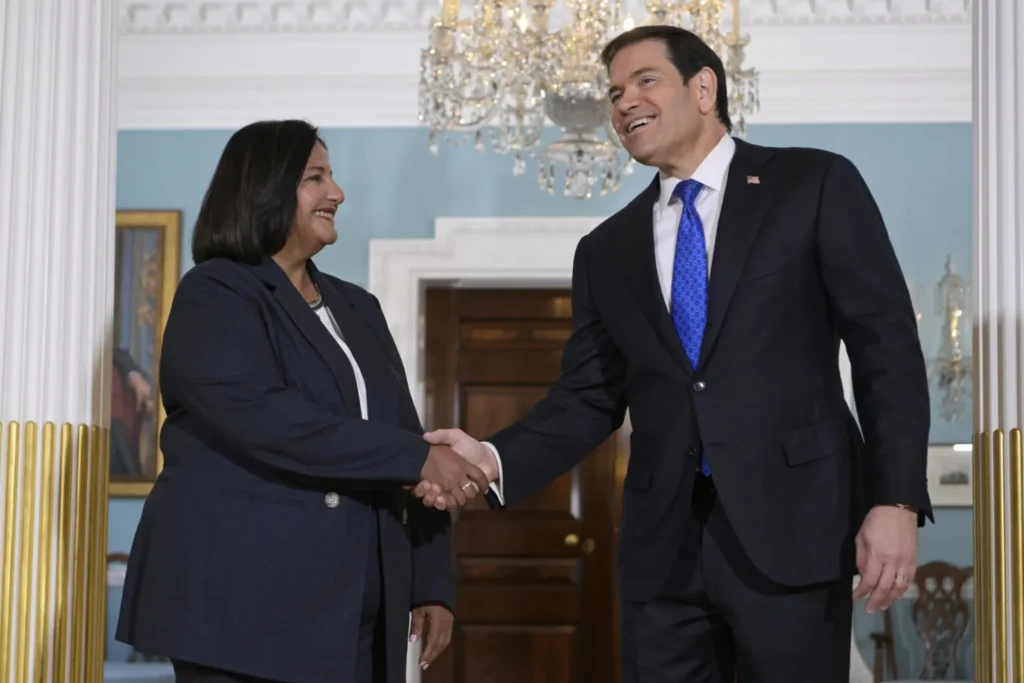
WASHINGTON, UNITED STATES — U.S. Secretary of State Marco Rubio greets Dinorah Figuera, leader of a Venezuelan opposition bloc, during a meeting at the State Department. Photo: EFE/Lenin Nolly.
Washington’s economic interests
Matheus acknowledged that the United States has explicit interests in Venezuela, particularly in the oil, energy, and mining sectors, as well as broader geopolitical objectives. Nevertheless, he argued that Washington has changed its approach to the country and that Rubio has emphasized the need to rebuild the state before establishing a functioning democracy.
“For a functioning democracy to exist, there must be state institutions that make it possible,” he stated.
According to the lawyer, holding elections before restoring those institutions could open the door to “an autocratic regression.”
To illustrate his argument, he compared Venezuela’s situation to that of a patient in intensive care who needs to recover before returning to everyday life.
“We cannot run the risk of such regressions after everything we have been through. That is why, once again, we need the minimum conditions,” he maintained.
The lawyer described the ongoing transformation as “irreversible,” both politically and economically. On the economic front, he argued that oil interests would remain in Venezuela “for decades,” despite the controversies surrounding agreements with businessman Alejandro Betancourt.
He also linked the country’s current stability to the U.S. military presence, which he characterized as “persuasive.”
On the political front, Matheus went so far as to suggest that Venezuelan democracy could become “the trophy that the Trump administration will showcase” ahead of the U.S. presidential election that will determine Trump’s successor.
“I am very optimistic, but I do not trust those on the other side of the table. We have to finish the job,” he warned.