Neirlay Andrade
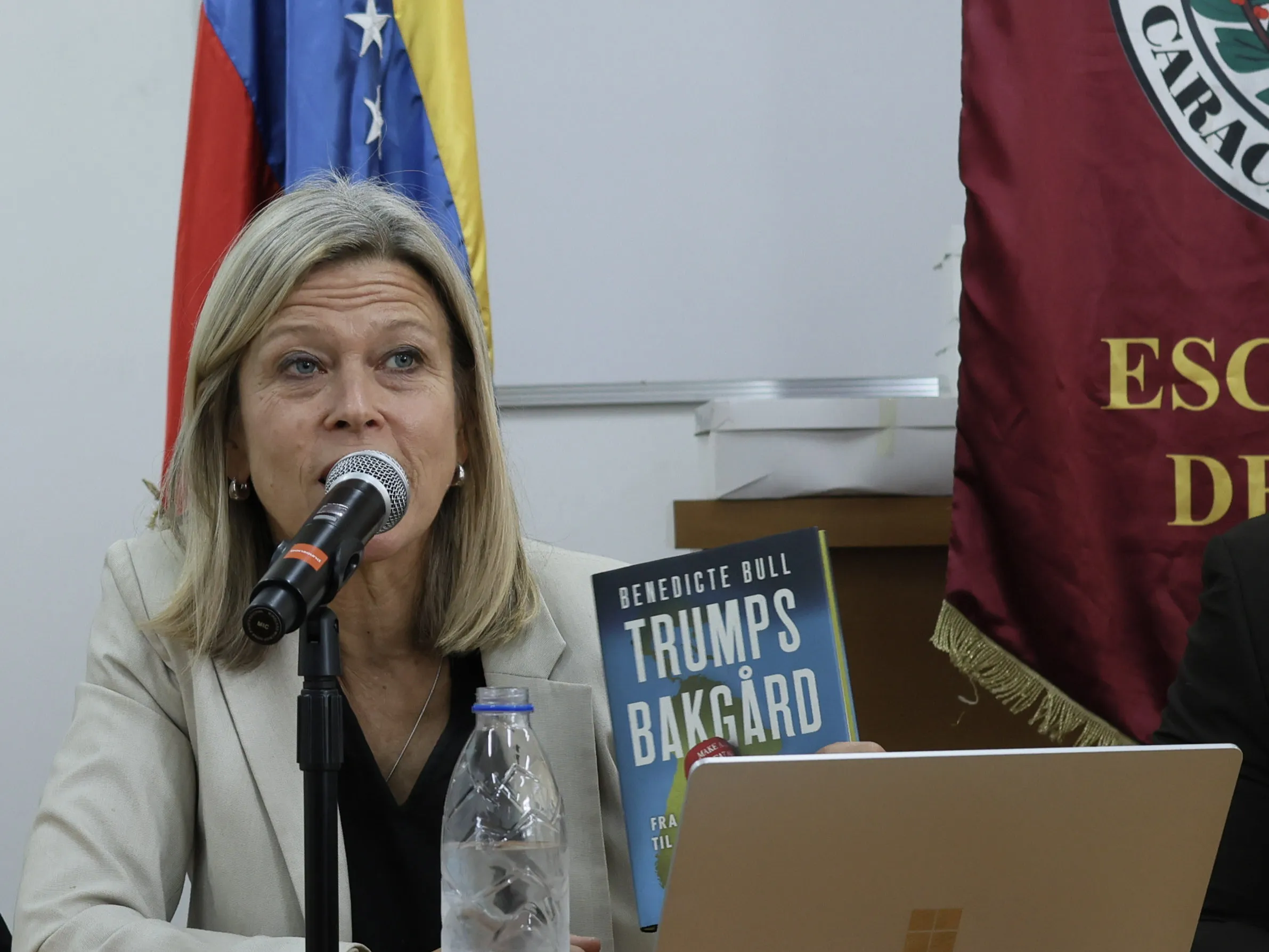
Political scientist Benedicte Bull, a professor at the University of Oslo, is visiting Caracas following the publication of her latest book, Trumps bakgård: Fra Monroe-doktrine til røverimperialisme i Latin-Amerika (Trump’s Backyard: From the Monroe Doctrine to Robber Imperialism in Latin America), in which she examines the consequences of Washington’s renewed offensive in Latin America. Bull takes Donald Trump’s inauguration speech on January 20, 2025, as her starting point, when the president announced that the United States would reclaim “its rightful place” among the nations of the world. Nearly two years later, the researcher examines the policy’s scope across the region.
Her analysis covers pressure on Panama’s government to remove Chinese companies from administering the interoceanic canal, the offensive against “narcoterrorism,” the creation of the Shield of the Americas, efforts to promote “friendly governments” aligned with U.S. interests, competition for critical minerals, and aggressive immigration policies.
However, one of the most significant episodes in understanding “Trump’s corollary to the Monroe Doctrine” is the U.S. military operation in Venezuela on January 3, 2026, an event that, according to Bull, exposed fundamental changes in the world order.
The Monroe Doctrine returns
Trump’s return to the White House in 2025 prompted Bull to examine the Monroe Doctrine’s continued relevance, which originated in 1823 and which some sectors had regarded as a relic of the past. Under the new U.S. administration, she argues, Washington has revived its ambition to exercise privileged influence over the Western Hemisphere.
Trump’s corollary—dubbed the “Donroe Doctrine” by the U.S. press—emerged clearly in the new National Security Strategy of December 2025. According to Bull, it pursues three objectives: containing migration to the United States, combating criminal organizations that Washington classifies as narcoterrorist groups, and ensuring the presence of governments willing to cooperate with U.S. strategic interests.
Competition with China adds another dimension. “Trump wants to keep China out to secure access to resources that are important to the U.S. value chain,” she explained.
The researcher cautions, however, that official documents alone cannot fully explain this policy. Understanding it requires comparing Washington’s stated objectives with its concrete actions.
“One thing is what Trump says, what he says in this strategy, and another is what is actually happening in practice,” she noted. This gap between rhetoric and action forms the starting point of her book.
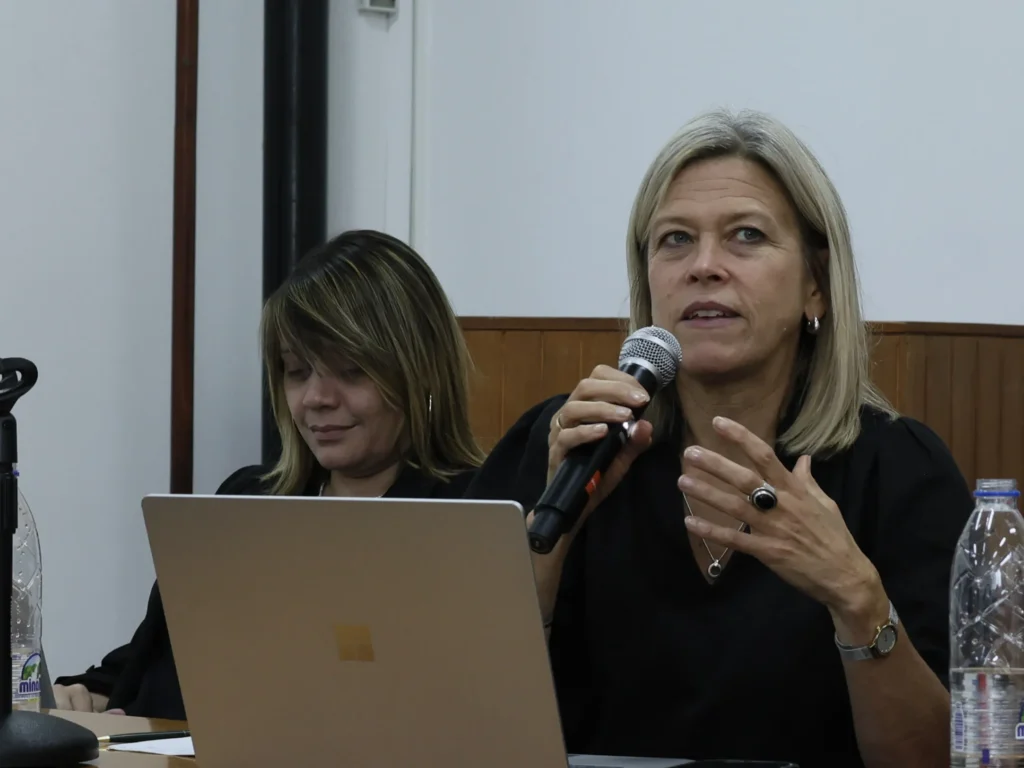
Photo: Jaimara Jabour / The Daily Journal
January 3 and the changing world order
The U.S. military operation on January 3, 2026, and the abduction of Nicolás Maduro occupy a central place in Bull’s analysis. At a conference organized by the Center for Development Studies at the Central University of Venezuela (Cendes-UCV), she explained that the event received extensive coverage in Norway, though from a perspective different from Venezuelans’.
“For Norwegians and Europeans in general, it was more of a signal that the world order had now changed,” she stated.
The central concern involved the erosion of national sovereignty and the absence of international consequences when a powerful country resorts to military force.
“The issue of sovereignty no longer means anything: you can enter a country and abduct its president without facing any consequences, without anyone protesting,” she argued.
Bull linked this international reaction to the U.S. bombings in the Caribbean during 2025, which she believes also drew an insufficient response. In her view, both episodes call into question the continued relevance of international law and the protections available to states confronting a militarily superior power.
Her analysis, however, does not overlook Venezuela’s political crisis before the intervention. “I knew very well what was happening here and how the regime had evolved from Chávez to Maduro, and how it had deteriorated for many reasons and in many aspects of life, but even more so after the July 2024 elections, becoming a brutal and authoritarian regime,” she stated.
Robber imperialism: Power serving private interests
The contradictions in Trump’s own statements further complicate efforts to interpret Washington’s policies. Bull recalled that the U.S. president had proclaimed himself “acting president of Venezuela” in a post on his social media platform, Truth Social, and had also raised the possibility of Venezuela becoming the 51st U.S. state.
For the researcher, these statements deserve analysis beyond their provocative nature. The key question is identifying the interests driving Washington’s decisions and understanding how its strategic objectives intersect with the benefits certain private actors may gain.
“I believe that to understand all these contradictions truly, we have to interpret Trump’s policies on two levels,” she explained.
The first involves U.S. national interests: geopolitical competition, rivalry with China, and access to strategic resources, including Venezuelan oil—the second concerns Trump’s personal interests and those of his closest associates.
This relationship between state power and private interests lies at the heart of her concept of “robber imperialism.” The analogy refers to those who used their power to extort others and obtain personal benefits.
“Something similar is happening with the United States now. They use their military power and enormous resources to extract very specific benefits,” she noted.
As examples of this dynamic, she mentioned Trafigura, an international commodities trading company involved in marketing Venezuelan oil, and North American Blue Energy Partners (NABEP). Regarding Trafigura, she claimed that the company ranks among the leading contributors to Trump’s political campaign. Meanwhile, NABEP manages the agreement that gives the United States control over one-fifth of Venezuela’s proven crude oil reserves.
The electoral path forward
Bull acknowledges that Venezuela’s sovereignty had already suffered serious violations before January 3, but she believes the country can still rebuild it.
“I believe sovereignty can be rebuilt, although right now it is difficult to envision because the United States holds so much power,” she stated.
To move in that direction, she defended the need to open a new political chapter through elections.
“We have to open things up—even if we disagree with the politics of the leaders who are currently best positioned to win these elections. We have to break things open, to pull the country out of its current situation,” Bull declared.
The university professor did not dismiss the debate over “whether institutions should be rebuilt before or after elections.” Still, she emphasized the importance of “pressing for elections, for change” and warned against the risk of consolidating a system of authoritarian capitalism.
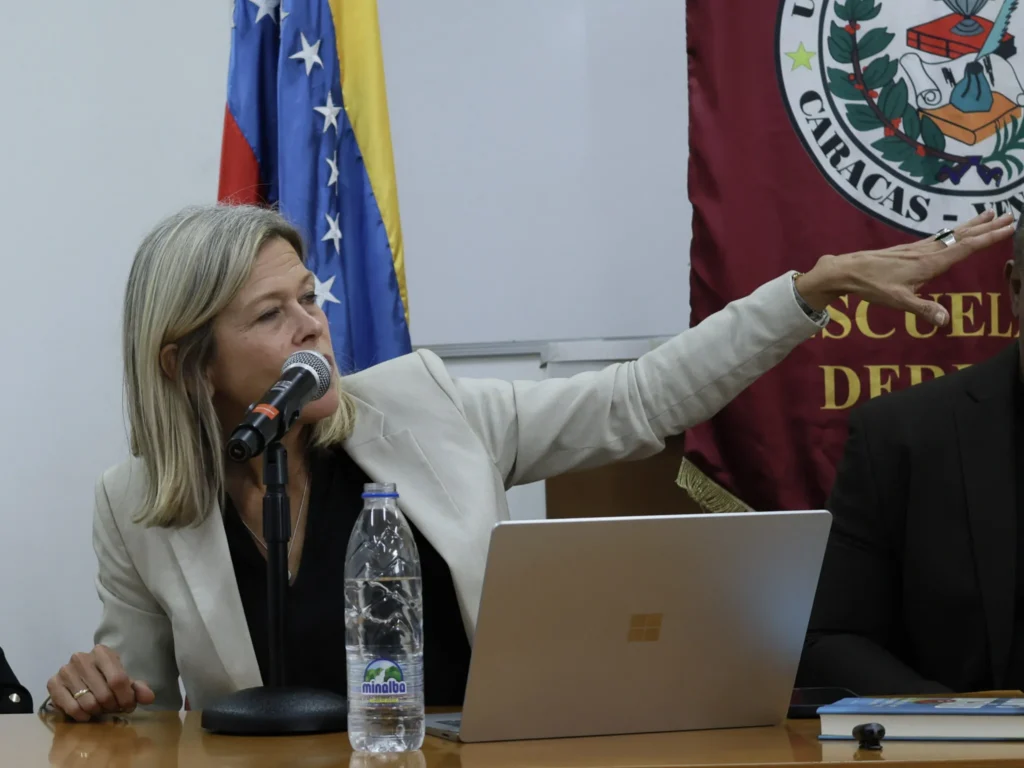
Photo: Jaimara Jabour / The Daily Journal
An interregnum
Bull questions what kind of global system the world is moving toward. The academic believes the international community is experiencing an interregnum, a transitional period whose outcome remains uncertain.
One possibility involves the emergence of a bipolar world, this time defined by competition between the United States and China, in which other countries would face pressure to choose sides. Another interpretation points toward a multipolar order, with several centers of power capable of competing while also cooperating.
Although the latter scenario appears more attractive, the political scientist warns that major powers still dominate even forums that advocate multipolarity. At the same time, smaller countries must decide which powers to align with.
“We are returning to a world of spheres of influence,” she argues. In this scenario, Latin America remains within the U.S. sphere of influence.
The question, then, is whether the region will once again fall under a framework similar to the Monroe Doctrine or whether it can pursue a policy of “active alignments”: “establishing trade relations with China, attracting European investment, maintaining ties with countries in Asia and Africa, and, at the same time, engaging with the United States.”
For Bull, no definitive answer has emerged. Nevertheless, she stresses that “Latin America is not condemned to U.S. domination.”
Although foreign observers may perceive external control over Venezuela as something “that will last forever,” the academic remains optimistic, pointing out that movements within the country are also “trying to take advantage of the situation to pursue their own democratic path of development.”