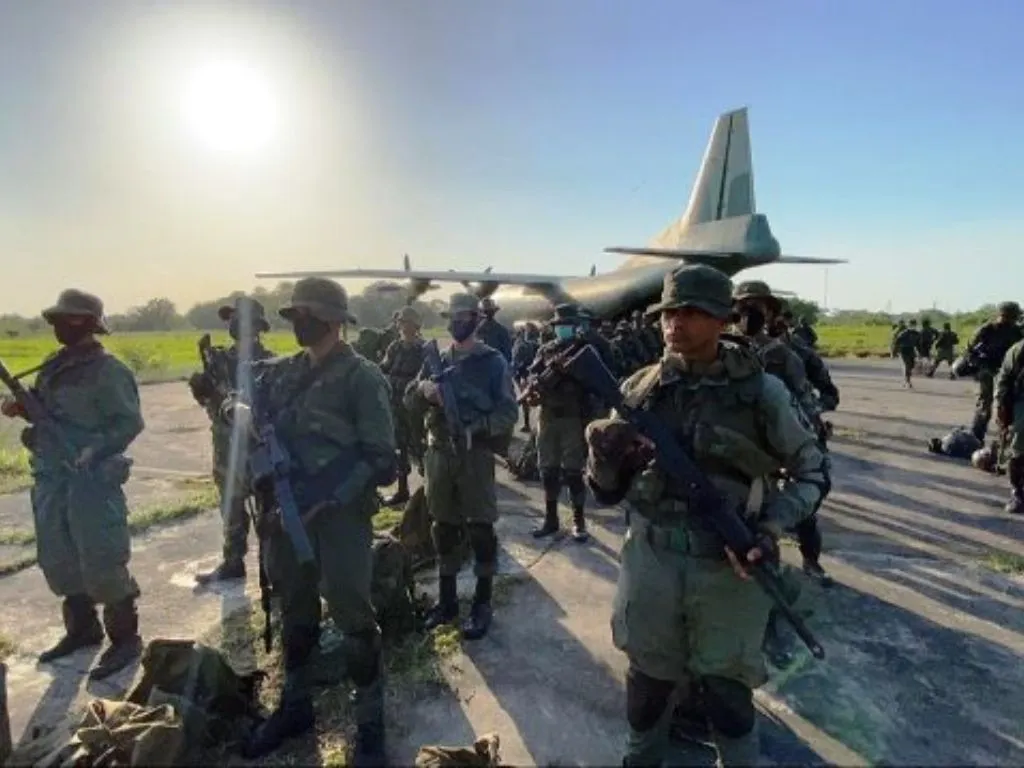
The Daily Journal.- On Thursday, November 12, Venezuela deployed a military operation involving the Bolivarian National Armed Forces (FANB) in Apure state, along the Colombian border, to strengthen security and combat drug trafficking, extortion, kidnapping, and smuggling. The deployment followed a security crisis triggered by the kidnapping of a Colombian Army officer in the border region.
Previously, the Venezuelan government expressed its willingness to establish the necessary institutional coordination with Colombian authorities on border security matters.
Through an official statement, Venezuela’s interim executive branch reaffirmed its commitment to working closely with Colombian authorities to strengthen security mechanisms along the border. “To this end, existing cooperation mechanisms, institutional channels, and bilateral contacts remain available to facilitate information sharing and coordinate any necessary actions,” the statement read.
The conflict began on the afternoon of Wednesday, November 4, 2026, when Second Lieutenant María Camila Pantoja Hernández, a member of the Colombian National Army, encountered two armed men on a motorcycle who abducted her while she traveled through the urban area of Saravena municipality, in the department of Arauca.
One day later, the Eastern War Front of the National Liberation Army (ELN) claimed responsibility for the kidnapping through a video that authorities authenticated. The footage showed the officer in good health but explicitly warned that any military rescue attempt would endanger her life and held the Colombian state responsible for anything that might happen to her.
On the military and intelligence front, the Colombian Army launched a joint operation with the Navy, Air Force, and National Police in rural Arauca. Authorities identified alleged local leaders known by the aliases “Cabras” and “Boyaco” as operators of urban surveillance networks that track military personnel newly arriving in the region.
However, Saravena’s proximity to the Venezuelan border immediately raised concerns in Bogotá that the kidnappers might have crossed into Apure state to evade pursuit. The security situation along the border deteriorated further following reports of a second kidnapping in the border region and threats by armed groups against community leaders.
Bilateral tensions escalated when Colombian President Abelardo de la Espriella demanded the second lieutenant’s immediate and unconditional release and ordered tighter border controls. Meanwhile, Colombian Defense Minister Jorge Mora announced that Bogotá would seek assistance from the United States, both for intelligence support and to encourage Washington to intervene with Caracas to secure Venezuela’s cooperation in the search.
This development comes amid growing operational cooperation between Washington and Caracas against the ELN. Weeks earlier, the two countries reportedly cooperated in an airstrike against a guerrilla camp in Apure, highlighting the distrust or lack of direct communication between the De la Espriella administration and Venezuela’s executive branch.
In direct response to Colombia’s request for U.S. mediation and mounting pressure along the border, Venezuela took two simultaneous steps on Thursday, November 12. First, the Foreign Ministry issued a statement reaffirming its willingness to cooperate on border security through existing bilateral channels, thereby avoiding U.S. involvement as an intermediary. Second, the Bolivarian National Armed Forces (FANB) announced a military deployment in Apure state to secure the border following the kidnapping.