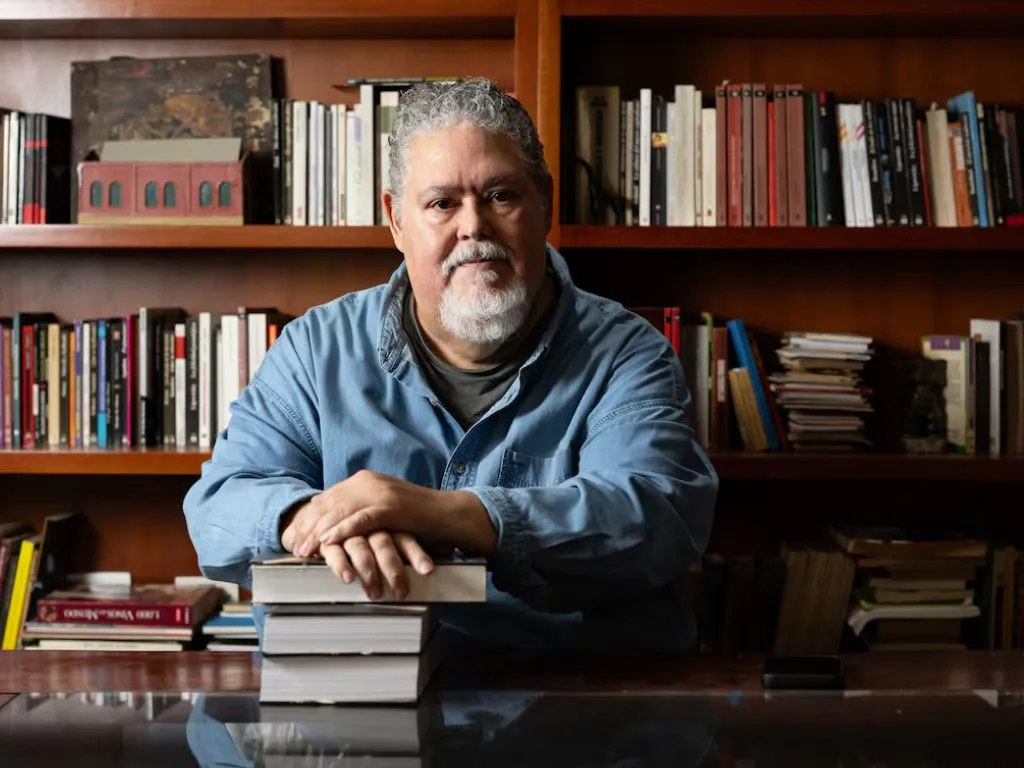
The Daily Journal — In an interview with the program Punto de Corte, former Metropolitan Mayor of Caracas and coordinator of the Redes Movement, Juan Barreto outlined a roadmap for Venezuela’s political transition focused on dismantling the repressive apparatus, international intervention in the judiciary, transitional justice without impunity, and redirecting military spending toward social needs.
During his conversation with journalist Nicmer Evans, Barreto, who holds a doctorate in Social Sciences and has worked as a journalist and lawmaker, presented a stark assessment of Venezuela’s institutional landscape. He argued that Venezuela lacks autonomous institutions and instead operates through a “mineralized” structure in which the state, the ruling party, the Armed Forces, and police agencies have merged into a tightly knit alliance that operates beyond the reach of citizens and the law.
According to Barreto, Nicolás Maduro’s government usurped popular sovereignty by disregarding the legitimacy conferred by citizens, transforming the state apparatus into something resembling an “armed gang” that controls territory and the population through force. This internal confiscation of sovereignty weakened national independence and ultimately triggered direct intervention by external powers.
In the aftermath of January 3, Barreto characterized the political situation as one of “foreign tutelage” resulting from U.S. military action. In his view, although the intervention brought a fragile opening and the release of some political prisoners as secondary consequences, the same ruling factions continue to share power under new rules imposed from abroad.
Intervention and dismantling of the police and judicial system
Confronted with the entrenched nature of the repressive apparatus, Barreto emphasized that superficial reforms or isolated elections cannot restore the country’s institutions. He therefore formally proposed a National Agreement to Intervene in and Restructure the Police and Judicial System, incorporating far-reaching reforms in the administration of justice, public security, and the allocation of government resources.
Regarding judicial reform, Barreto argued that courts and institutions such as the Supreme Court of Justice and the National Electoral Council function as little more than empty shells subordinate to political power. To restore judicial independence, he proposed seeking international assistance and oversight from the United Nations and transitional justice mechanisms, including appointing international transitional judges to provide legal support and ensure the system’s renewal.
He also advocated a constitutional reform allowing citizens to directly elect the country’s judges and prosecutors through popular vote, thereby democratizing the administration of justice from the bottom up.
Regarding police reform, the political leader called for sweeping intervention in security agencies to eradicate extortion practices known locally as matraqueo, arbitrary detentions, and state terrorism. His proposal includes dismantling the repressive police structure, conducting a comprehensive review of military and police doctrine, and openly evaluating the possibility of requesting a United Nations Blue Helmet peacekeeping mission to guarantee public security during the transition.
Additionally, the Redes coordinator sharply criticized the allocation of public funds to defense and secret budgetary expenditures. He proposed establishing a social fund financed by redirecting military and police spending toward pressing social priorities.
The fund would prioritize decent salaries for teachers and public-sector workers, along with immediate improvements to basic services and the country’s social infrastructure.
Accountability and transitional justice
Addressing the debate over national reconciliation, Barreto categorically rejected any proposal based on simply “wiping the slate clean.” He stressed that lasting peace requires truth, transparency, accountability, and appropriate reparations for victims of human rights violations.
To implement this transitional justice framework, his proposal outlines concrete measures in three essential areas.
Regarding financial accountability, it calls for mandatory, rigorous audits of the assets and fortunes of all current and former public officials, whether elected or appointed, extending the scrutiny to their immediate family members.
In criminal matters, Barreto demanded that authorities initiate investigations on their own initiative to determine the potential responsibility of Nicolás Maduro, members of his family, former attorneys general, and former ombudsmen in connection with allegations of torture, unlawful searches, and abuses of state power.
Barreto emphasized that the entire process must follow strict procedural safeguards, guaranteeing due process, the presumption of innocence, and the full right to legal defense for everyone under investigation.
Why Maduro’s return is no longer viable
In his assessment of the current political landscape, Barreto categorically ruled out the possibility of Nicolás Maduro returning to power.
He argued that the former president currently represents Donald Trump’s most significant political and military victory, placing Maduro in a position of extreme institutional weakness that compels him to cooperate with investigations.
Furthermore, Barreto highlighted the emergence of a complex network of new actors, socioeconomic alliances, and de facto power structures within Venezuelan society that, in his assessment, make a return to the previous governing arrangement impossible.
He described this transformation as a point of no return in the country’s political dynamics.
The ladder of unity
To advance the democratic transition, Barreto introduced the “Ladder of Unity,” a political strategy designed to build consensus from the bottom up, based on the population’s actual needs.
The initiative first calls for the urgent organization of an electoral week featuring coordinated general elections to simultaneously renew the National Assembly, state governorships, mayoralties, and municipal councils.
Second, it proposes fully restoring the political rights of disqualified political leaders and overturning judicial measures against political organizations such as the Redes Movement. Barreto described the Supreme Court of Justice’s decision to disqualify Redes as a serious violation of political communities’ rights.
Finally, the proposal calls for a programmatic pact focused on quality of life, bringing together diverse social sectors, opposition groups, and dissident Chavistas under a unified agreement.
The pact would prioritize defending decent wages, restoring public services, and guaranteeing fundamental democratic rights.
Barreto concluded by reaffirming his willingness to engage in dialogue and reach concrete agreements with all political forces in the country, including María Corina Machado, based on mutual respect and equality.
He maintained that national reconstruction requires dismantling repressive structures and building a transparent, independent justice system.