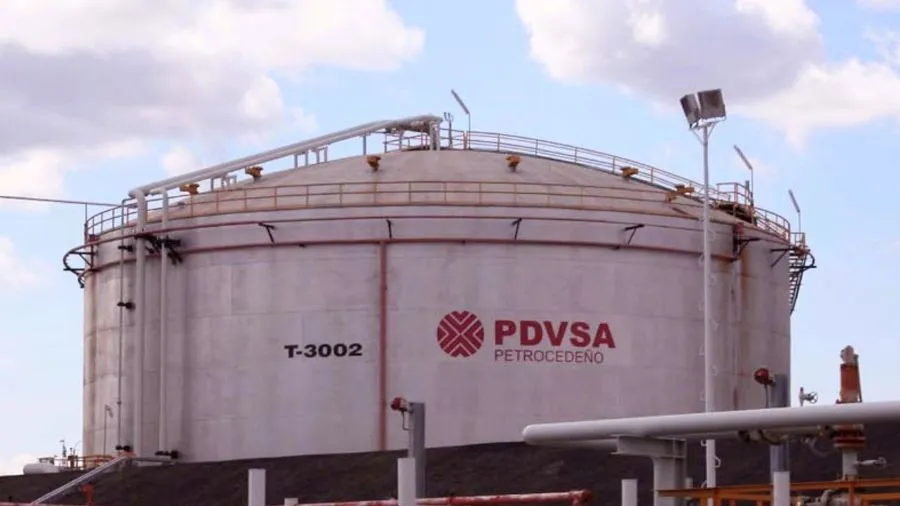
Alejandro Betancourt’s company aims to restore the extra-heavy crude oil upgrader to reduce diluent costs and expand production in the Orinoco Oil Belt
The Daily Journal – North American Blue Energy Partners Inc. (Nabep) will take control of the Petrocedeño extra-heavy crude oil upgrader this month, a strategic facility for its expansion plans in Venezuela’s oil industry, and expects to reactivate it within 24 months, according to Bloomberg.
“We will take control this month,” Nabep CEO Alejandro Betancourt said Monday during an interview in Caracas. The businessman said the facility is part of the oil agreement announced in August between the company and the U.S. government.
Restoring Petrocedeño would allow Nabep to reduce costs associated with handling and transporting the extra-heavy crude it produces in the Orinoco Oil Belt while addressing one of the main bottlenecks limiting its operational expansion.
The company currently blends extra-heavy crude with naphtha to facilitate transportation and exports. Petróleos de Venezuela (PDVSA) supplies the diluent through crude oil swaps. Still, the arrangement requires exporting naphtha and then importing it again, adding logistics costs and tying up capacity in pipelines and terminals.
By restarting the upgrader, Nabep expects to separate the naphtha from the crude at Petrocedeño and return it to PDVSA’s pipeline system for reuse in its oil fields, restoring the circulation system for which the facility was originally designed.
The plant will also produce light synthetic crude with an API gravity ranging from 28 to 32 degrees, which the company will subsequently blend with extra-heavy oil to obtain Merey 16, Venezuela’s main export crude grade, Betancourt explained.
Sulzer to participate in Petrocedeño’s rehabilitation
Swiss industrial company Sulzer announced an agreement with Nabep to support the upgrader’s rehabilitation by supplying a new atmospheric distillation column to replace the unit damaged by an explosion and fire in November 2025.
The contract also includes components for existing towers and maintenance services. According to Sulzer, replacing the damaged column represents a crucial step toward restoring the facility’s operational capacity.
France’s TotalEnergies and Norway’s Equinor previously operated Petrocedeño before withdrawing in 2021. Both companies had maintained partnerships with PDVSA since the 1990s.
Nabep aims to increase production to 250,000 barrels per day
Restoring the upgrader forms part of Nabep’s expansion strategy in Venezuela, where the company currently produces approximately 225,000 barrels of oil per day and expects to increase output to 250,000 barrels per day by the end of 2026.
In the Orinoco Oil Belt, the company produces approximately 70,000 barrels per day across the Ayacucho 6, Junín 10, and Zuata 2 blocks. It plans to increase that volume to 120,000 barrels per day by the end of 2027.
At the Junín 10 block, Nabep is testing steam injection to boost crude oil extraction. According to Betancourt, the pilot project has reportedly doubled production per well, from 500 to nearly 1,000 barrels per day.
The company currently operates six drilling rigs in the block and plans to add a seventh. The technique involves injecting steam approximately once a year throughout each well’s estimated eight-year productive lifespan.
Infrastructure and export expansion
Nabep is also strengthening its logistics capacity to support production growth. The company is expanding its terminals in Venezuela and leasing approximately three million barrels of storage capacity in Curaçao, from where it exports oil produced in western Venezuela.
Betancourt indicated that the company could expand its storage capacity, although he considers the current volume sufficient to support its short-term growth plans.
The company focuses its exports on Merey 16 and Blend 17 crude grades, while also marketing smaller volumes of Blend 14 and Blend 19. Its commercial strategy prioritizes three- to six-month contracts and spot sales rather than committing production through long-term agreements.
Nabep became a strategic partner of the U.S. government in August through an oil agreement that grants Washington a 35% stake in the company’s parent entity and preferential access to its crude oil supplies.
The agreement covers 17 Venezuelan oil fields with estimated reserves of 65 billion barrels and includes investments approaching US$100 billion, according to previously disclosed terms.
With information from Bloomberg.