By Óscar Reyes Matute
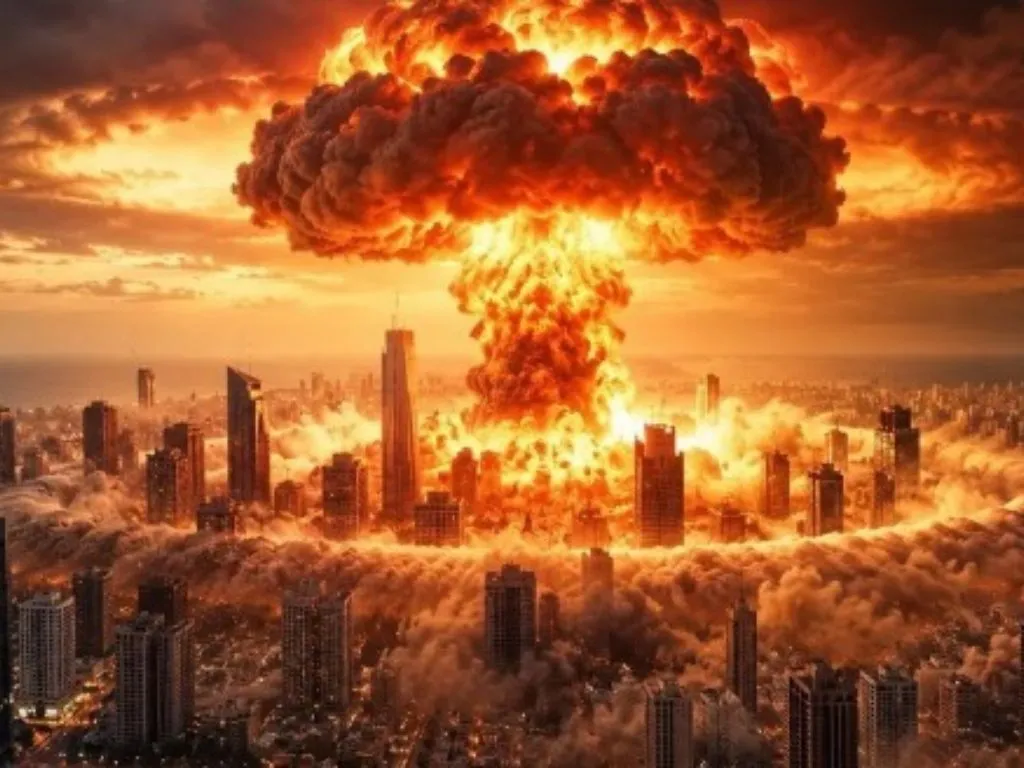
Ahead of tomorrow’s elections, Benjamin Netanyahu has allegedly published an AI-generated image reminiscent of the phrase attributed to French King Louis Capet XIV: “After me, the deluge,” depicting a nuclear bomb exploding over Tel Aviv. It serves as a reminder that he is the one who has waged war against Hamas in Gaza, the Houthis in Yemen, Hezbollah in Lebanon, and Iran, alongside the United States. His guiding principle is simple: it is unwise to change horses in the middle of a war.
The report states: “Prime Minister Benjamin Netanyahu shared an artificial intelligence-generated image on X on Sunday, two days before the elections, showing a nuclear explosion in Tel Aviv. He then wrote: ‘The State of Israel faces a real and tangible existential threat. If the Iranians acquire nuclear weapons, nothing will ever be the same again.’”
Whether he actually posted it or not makes little difference: disinformation, confusion, and chaos are weapons of war.
At this moment, Israel is not experiencing airstrikes, while Iran is busy attacking its former allies.
But ultimately, Israelis, both at home and abroad, are exhausted by war. After the devastation that the United States and Israel have inflicted on Iran, killing its military and religious leadership, destroying its air force and navy, and following the blockade of the Strait of Hormuz, they long for some semblance of “normalcy,” even if it resembles the world of the television series Fauda: peace amid chaos, one night, one day, before the apocalypse erupts once again.
Polls conducted one day before the elections reveal uncertainty in the political center, the very ground where coalitions will have to take shape to secure a majority.
Israel does not directly elect its prime minister. Instead, voters elect the 120 members of the Knesset (Parliament). To govern, a coalition must secure at least 61 seats.
The main contest pits Prime Minister Benjamin Netanyahu’s right-wing bloc (Likud), along with his religious and far-right allies, against the centrist and center-left opposition bloc.
Although Likud generally remains the party with the largest projected seat count, forming a government depends entirely on alliances.
Pre-election polls paint an extremely tight race in which neither Netanyahu’s governing bloc nor the opposition bloc has secured a decisive projection of the 61 seats needed for a majority, leaving the outcome in the hands of smaller parties or complex post-election negotiations.
The main political leaders and candidates
– Gadi Eisenkot (Yashar / Center): The former Chief of the General Staff of the Israel Defense Forces leads the independent centrist party Yashar. Polls place Eisenkot at the top of party voting preferences (approximately 21 to 23 seats), and he surpasses Netanyahu in direct personal preference for prime minister (49% versus 41%), emerging as the leading alternative on security and national unity.
– Benjamin Netanyahu (Likud / Right – Incumbent): The current prime minister seeks another term in office. His party, Likud, is competing for first place, averaging between 19 and 21 seats. With continued support from his core conservative and ultra-Orthodox base, Netanyahu is fighting to remain in power.
– Naftali Bennett and Yair Lapid (B’Yachad / Center-Right and Center): The two former prime ministers formed the Together (B’Yachad) alliance. Polls position them as the third-largest political force, with a projected 14 to 15 seats. Bennett, whose profile combines conservatism and a technocratic approach, also leads Netanyahu in direct head-to-head preference surveys.
– Avigdor Liberman (Yisrael Beytenu / Secular Right): The former defense minister remains a key political figure, bringing together right-wing voters who do not align with Netanyahu and members of the Russian-speaking community. Polls project approximately eight seats for his party.
– Itamar Ben-Gvir (Otzma Yehudit / Far Right): A key partner in the current governing coalition, he maintains steady electoral support, averaging seven to eight projected seats, and continues to push for a hardline government.
– Ultra-Orthodox Parties (Shas and United Torah Judaism): These parties maintain their traditional electoral base, contributing approximately 15 combined seats to Netanyahu’s political camp.
– Arab Parties (Ra’am and the Joint List): Together, they project between 14 and 15 seats.
Who is leading, and what lies ahead?
Although the opposition bloc, with Gadi Eisenkot emerging as its informal frontrunner in voter preferences, holds an advantage over Netanyahu’s governing bloc (with an average projection of 54 opposition seats compared with 48 to 50 seats for Netanyahu’s bloc), neither side independently reaches the absolute majority of 61 seats required in the 120-member Knesset.
If voters confirm these figures at the ballot box, the results could lead to parliamentary deadlock, opening the door to complex negotiations over a national unity government or intense political tensions surrounding coalition-building.
Tomorrow will tell.