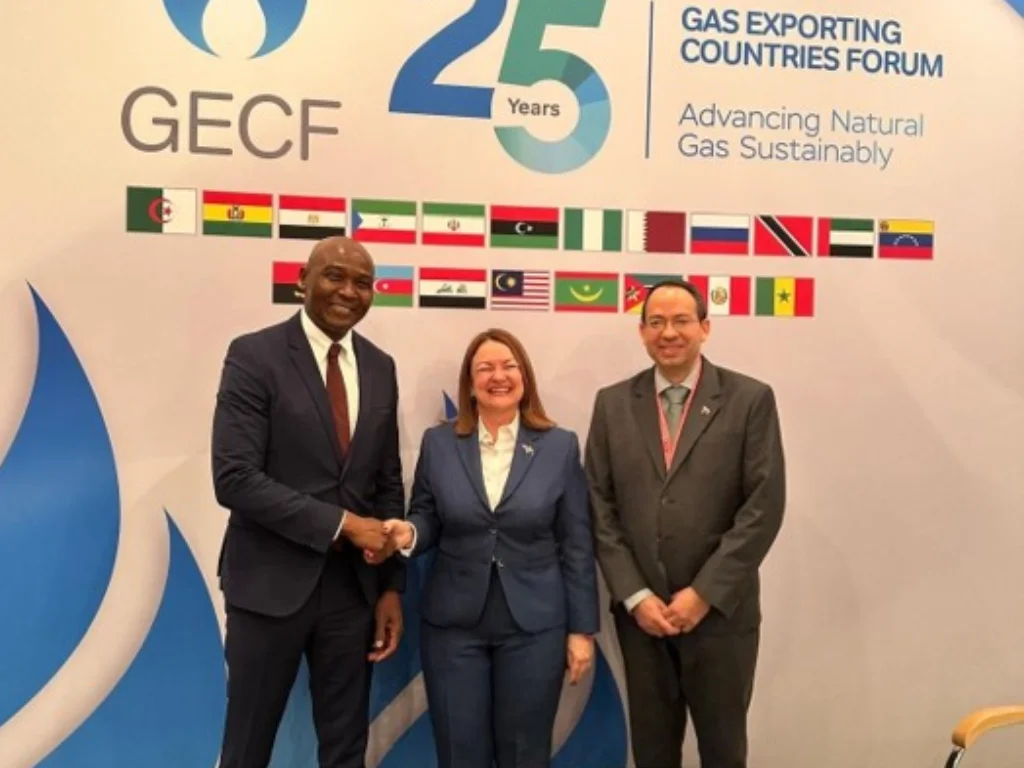
The Daily Journal.- Venezuela’s Hydrocarbons Minister, Paula Henao Vera, held a bilateral meeting with Philip Mshelbila, Secretary General of the Gas Exporting Countries Forum (GECF), in Moscow during the organization’s 8th Summit.
During the meeting, Mshelbila highlighted Venezuela’s natural gas potential and the strategic importance of this resource for the country’s economic development.
The meeting took place alongside activities related to the GECF’s 28th Ministerial Meeting, where Venezuela is participating with a delegation led by Henao to discuss energy security, sustainable development, and cooperation among gas-producing countries.
In her remarks, the minister noted that Venezuela holds the world’s fourth-largest natural gas reserves and reaffirmed the country’s commitment to international cooperation, according to reports.
Investment and energy security
The GECF agenda includes natural gas’s role in energy security, structural changes in the global market, sustainable investment, and stronger dialogue between producers and consumers.
Iran’s ambassador to Moscow, Kazem Jalali, told the Russian news agency RIA Novosti that discussions would also address technological development and the protection of critical energy infrastructure.
These issues hold particular significance for Venezuela, given the need to develop its natural gas resources and create conditions that allow the country to increase their utilization. However, vast reserves do not automatically translate into equivalent production or export capacity.
The GECF comprises 12 member countries: Algeria, Bolivia, Qatar, Egypt, the United Arab Emirates, Equatorial Guinea, Iran, Libya, Nigeria, Russia, Trinidad and Tobago, and Venezuela.
According to the organization’s figures, its members hold approximately 70% of the world’s proven natural gas reserves, account for 38% of global production, and represent 42% of worldwide gas exports. They also account for 47% of global liquefied natural gas (LNG) exports.