The Daily Journal.- “The possible political transition Venezuela is experiencing is neither a predetermined script nor a label that we can apply lightly. It represents a change of eras, realities and circumstances.”
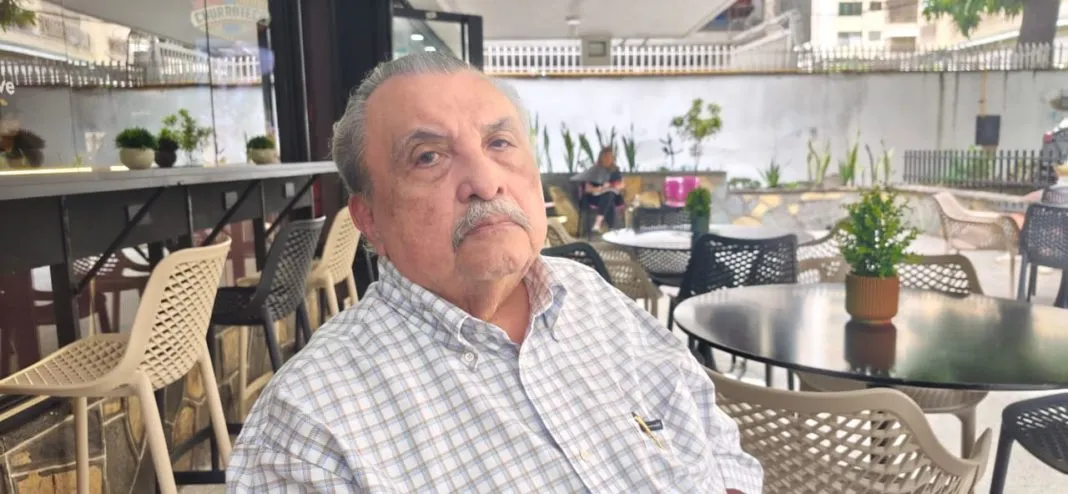
These words belong to Manuel Felipe Sierra, a Venezuelan journalist, political analyst, and writer with more than six decades of experience in the country’s leading media outlets. Born in Coro, Falcón state, in 1943, Sierra has earned widespread recognition for his analytical approach and his longstanding defense of democracy and electoral processes in Venezuela.
“The serious mistake many people make is talking about transition as though it were simply a label. It is a complex, difficult process, with characteristics unique to each case,” he emphasized.
It is a hot Saturday afternoon in eastern Caracas, where we meet to discuss his views on Venezuela’s current situation. The clock strikes two, and an unusual traffic jam has brought Chacao to a standstill. The noise of car engines and horns dominates the afternoon, making it hard to articulate ideas amid the city’s bustle. Against this backdrop, the journalist maintains that “the transition in Venezuela today is not part of a prewritten script.”
Addressing the circumstances surrounding the recent U.S. military intervention and President Nicolás Maduro’s removal from power, Sierra describes the country as experiencing an “ever-changing reality.” Although the intervention played a leading role at the outset, it does not define the entire process. “Today we face a new political reality, marked by the establishment of dialogue mechanisms and the Venezuelan people’s demand for a new way of governing,” he explained.
Within this context, the analyst sees a shift toward a social market economy, moving away from previous socialist-oriented policies. “We are talking about broad, democratic economic openings,” he noted, warning against interpreting the process dogmatically, since even transitions can lead to regression if those involved fail to manage them clearly.
Sierra, the author of monographs and books documenting Venezuela’s contemporary political evolution, including Los Hilos del Poder, Quince Años de Evolución Política, and Fábulas de Carne y Huesos, as well as biographies of historical figures such as communist leader Gustavo Machado and former President Marcos Pérez Jiménez, argues that “the transition must create the necessary conditions to call elections.”
The interviewee chooses his words carefully. In a slightly raspy voice, he weighs each idea before laying out his arguments about Venezuela’s political transition.
Throughout our pleasant conversation, Sierra shares a wealth of personal anecdotes, creating moments of laughter and nostalgia.
—What does political transition mean in Venezuela’s current circumstances?
—Transition means a change of eras, a change of realities, a change of circumstances. Simply put, transition means changing everything: replacing one government with another, one political model with another, and the period in between. That is a transition: a period of change, however you choose to explain it. But transitions are, by nature, extremely complex.
—Are all transitions alike? Do political transitions follow similar patterns around the world?
—No. Every transition is different. Some begin with initiatives from civil society, others through coups d’état, and still others through unexpected developments. Social, economic, and political transitions have their own characteristics. I believe a serious mistake many people make is treating transition as if it were simply a label. Transition is a complex, difficult change, with characteristics unique not only to each country but also to each case. That is why I believe Venezuela’s situation attracts attention, because it is unfolding in a particularly unusual way, even within Latin America.
—Following the U.S. military intervention on January 3, are we witnessing a transition under foreign supervision?
—The U.S. military intervention played a leading role at the beginning of a possible transition. But now it is not everything. It is part of the process, not the whole process. They took President Nicolás Maduro away, and now we have an interim presidency that determines the political future of the country and the Venezuelan people. What we are experiencing means that a new reality exists, one we can interpret and describe as a transition. Venezuelans now demand a new way of governing our country. Today, we face a different political reality, marked by dialogue between Jorge Rodríguez and Dinorah Figuera following the U.S. government’s military intervention.
—Amid these circumstances, are we witnessing political change in the country?
—Well, I think it is important to say that the situation is very complex, but there is clearly a political change. The real aspiration undoubtedly involves economic and social transformation. For example, you can see that President Delcy Rodríguez’s approach to governing considers many factors. But this new reality would not necessarily invalidate the original ideas of dissatisfied Chavismo. Work is now underway to establish a new Supreme Court of Justice and a new National Electoral Council. We will have to wait and see.
—Are we seeing a lack of economic liberalization?
—We understand that this change involves a liberal market economy. We are moving from a supposedly socialist-oriented economy toward a social market economy. The previous approach no longer applies as the country works to establish a new Supreme Court of Justice (TSJ) and make a new National Electoral Council possible. That represents a change, an important change, particularly regarding the need for certain economic measures. We are talking about broad, democratic economic openings.
But I repeat: transition does not follow an already established script. We cannot interpret this reality dogmatically. It is a complex, unprecedented process. A transition can even become regressive in the end. What is certain is that we face an ever-changing reality undergoing constant transformation. Otherwise, it would be very easy to assume that the outgoing regime accepts everything that follows, while the incoming one rejects everything that came before.
—How do you interpret this transition in relation to the electoral situation? When will Venezuela hold elections?
—The transition must create the necessary conditions to call elections. I do not believe they will happen immediately. It is urgent to organize free elections under the protection of our constitutional order.
Consider, for example, Venezuela’s transition following the fall of Marcos Pérez Jiménez’s dictatorship. We could also discuss earlier transitions, such as the one following Juan Vicente Gómez’s death in the early twentieth century and everything that process meant for Venezuela.
But transitions take time, and elections can only take place when a new reality emerges, allowing the electoral results to reflect the balance of political forces.
—Do you envision the next presidential elections with or without María Corina Machado?
—Look, I don’t know. We would have to see. But I think perhaps she will participate. Speculating now would be premature, although I believe it will happen.
The opposition should remain united. Otherwise, Chavismo will win if the opposition enters the next presidential elections divided.
And I think this has a great deal to do with María Corina Machado understanding what is happening, because she seems attached to a position that does not match the current reality. Donald Trump’s views also influence this situation.
—How would you define the proposal for a transition toward a Sixth Republic in the short term?
—I believe the country is already moving toward a Sixth Republic. We can no longer say we are at the height of Chávez’s Fifth Republic. We are moving toward a new form of democratic transition.
I would not call it a model, but rather a form of government that will necessarily combine many of the lessons of the Fourth Republic, including the concept of direct democracy.
—Is establishing a Sixth Republic viable in twenty-first-century Venezuela?
—It is viable, but under the concept of a social democracy rather than a representative one.
We must understand that, over these 27 years, the political and economic results have not met expectations. There has been significant social participation in politics through the proposals introduced at the time, perhaps in a demagogic manner, and perhaps the final results contradicted the original intentions.
Nevertheless, today’s Venezuela has a different social landscape than in 1999. I mean a democracy that shifts toward the social dimension and moves away from the purely representative model.
—How important is civil society in bringing about the changes the country demands, particularly amid proposals for a Sixth Republic?
—Civil society now plays a new and more important role than ever. Civil society participates directly in potential changes and carries decisive weight in shaping them.
What we call civil society has, in some ways, taken over the role that political parties once performed. Political parties used to represent different social sectors. Today, those sectors have their own direct presence and identity, and we cannot treat them according to the old party structure.
Today, civil society has replaced political parties as a driving force behind social change.
—How do you envision the country’s immediate future?
—With great faith and optimism about what lies ahead. Of course, we must understand that politics and history always involve confrontation, but I believe an important opportunity is opening up in Venezuela.
What matters is that political forces on both sides understand this opportunity from a democratic perspective. We are experiencing a new chapter in our national history.
—What does the concept of a Sixth Republic mean to you from a social perspective?
—It must involve a cultural transformation in which civic awareness takes center stage, allowing the country to move toward a new social, political and economic future.
Despite the moment’s complexity, Manuel Felipe Sierra concluded the meeting with a message of optimism.
“I have great faith in what lies ahead,” he said, expressing confidence that political forces on both sides will recognize that Venezuela is experiencing a new historical chapter that requires, above all, cultural transformation and a renewed emphasis on civic awareness.
By Dr. Yahvé Álvarez (Journalist and Historian) — @yahveal