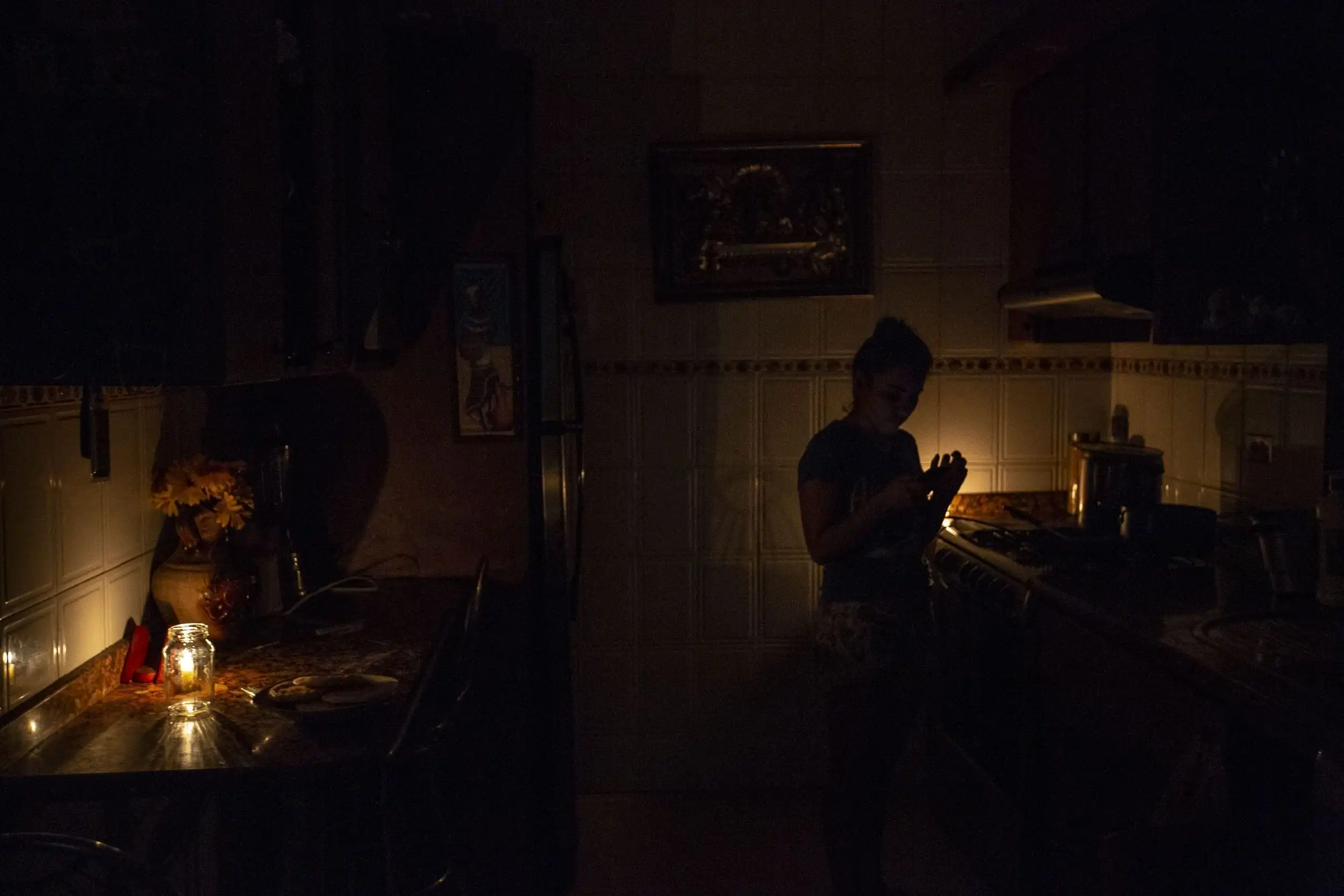
The Daily Journal. — In Venezuela, 57.5% of households experience unplanned power outages “every day or almost every day.” In comparison, 68.5% of affected households endure blackouts lasting more than three consecutive hours, according to the October 2026 Latam Pulse: Venezuela survey conducted by AtlasIntel and Bloomberg.
The survey, conducted between November 5 and 9, 2026, among a nationwide sample of 2,492 adults with a margin of error of ±2 percentage points, shows that electricity supply failures are the worst-rated area of Acting President Delcy Rodríguez’s administration, with a net approval rating of -73 percentage points.
When respondents evaluated the government’s performance in managing electricity services, 74% described it as “terrible” and 9% as “poor,” bringing overall disapproval in the sector to 83%. Only 6% rated its performance as “good,” 4% as “excellent,” and 7% as “fair.”
Regarding the frequency of unplanned outages over the past 30 days, in addition to the 57.5% who reported disruptions “every day or almost every day,” another 19.7% experienced outages “several times a week,” 7.1% “once or twice a week,” and 8.2% “once or twice a month.” Only 7.4% reported experiencing no power interruptions during the past month.
The figures reveal significant disparities between the capital and the rest of the country. While daily or nearly daily outages affect 23.7% of households in the Capital Region, the figure rises to 90.3% in the Andes, 77.3% in the Zulia Region, 74.5% in the Central Region, 58.8% in the Eastern and Insular Region, 55.5% in the Central-Western Region, and 51.4% in the Llanos and Guayana Region.
The duration of these interruptions further intensifies their economic impact on households and businesses. Among respondents who experienced power outages during the past month, 38.4% reported that blackouts typically last “more than six hours,” while another 30.1% said they continue for “between three and six hours.” Meanwhile, 8.3% reported interruptions lasting “between one and three hours,” 10.0% “between 30 minutes and one hour,” and 4.9% “less than 30 minutes.” Another 8.1% answered that the duration “varies too much” or that they did not know.
The geographical breakdown shows that outages exceeding six hours hit the Central Region hardest (65.5%), followed by the Central-Western Region (51.0%), the Zulia Region (42.5%), the Llanos and Guayana Region (42.1%), the Andes (37.5%), and the Eastern and Insular Region (37.1%). By comparison, the Capital Region recorded 10.1%.
When researchers asked respondents about the structural causes behind the deterioration of electricity services — allowing participants to select up to two answers — two-thirds of the population (66.4%) attributed the system’s current problems to a “lack of investment and maintenance.”
“Corruption” ranked second at 29.6%, followed by “poor management” at 27.8%. Respondents assigned considerably less importance to official or external explanations, including “increased electricity consumption” (6.7%), “international sanctions” (5.9%), “sabotage” (5.8%), and “damage caused by natural events” (2.7%). Another 1.9% selected “other,” while 10.0% answered, “don’t know.”
Despite the restructuring and investment-attraction plans announced by the acting government for the energy sector, public skepticism about a swift stabilization of the electricity grid remains widespread.
When researchers asked respondents how confident they were that electricity services would improve significantly over the next two years, 54.3% expressed pessimism, with 37.2% reporting “little confidence” and 17.1% “no confidence at all.”
Conversely, 33.4% expressed optimism, including 18.9% who reported “considerable confidence” and 14.5% who expressed “a great deal of confidence.” The remaining 12.3% answered, “don’t know.”
The deterioration of electricity services also represents a potential source of social unrest and economic pressure.
A total of 25.4% of respondents reported participating in protests over electricity failures in their regions during 2026, with the highest participation rates in the Zulia Region (36.4%), the Capital Region (32.4%), and the Andes (29.2%). Meanwhile, 74.6% stated that they had not participated in such demonstrations.
Among those who had not joined protests this year, 39.5% stated that “nothing” would motivate them to protest over electricity issues. However, other respondents identified specific circumstances that could prompt them to demonstrate.
These included “going 12 hours or more without electricity” (27.8%), “repeated damage to household appliances or equipment” (25.5%), “higher electricity rates without service improvements” (19.2%), “daily or almost daily outages” (19.1%), “lack of information or response from authorities” (14.7%), and “outages lasting more than three hours” (7.5%). Another 7.4% selected “other.”