Vanessa Davies
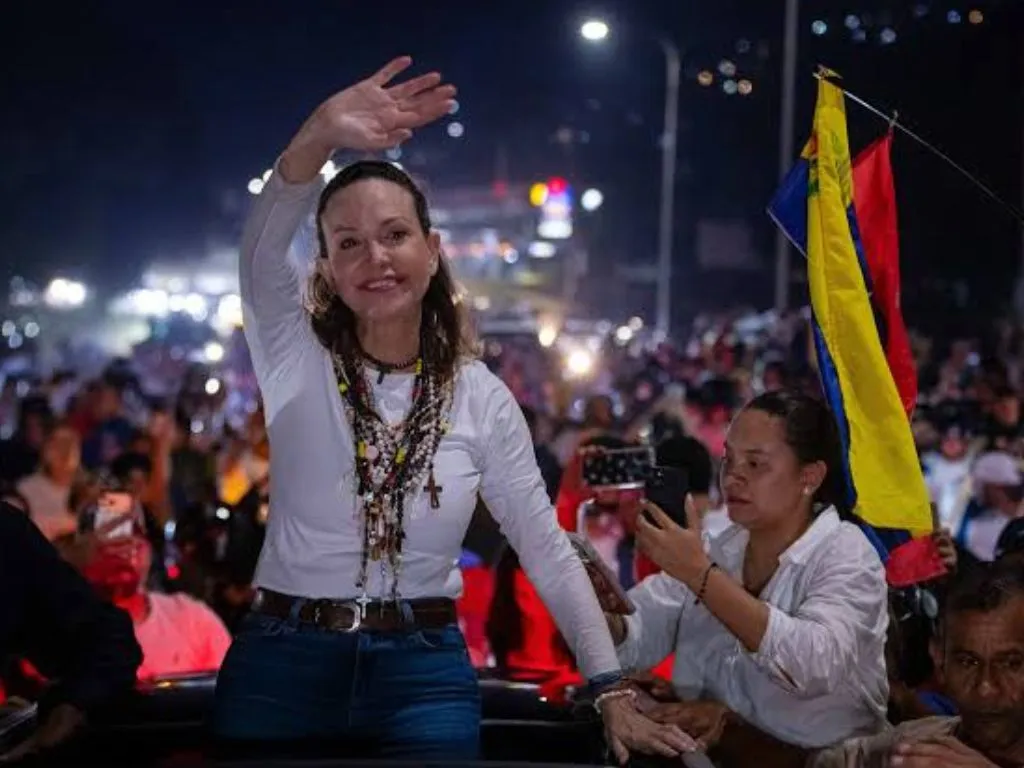
The Daily Journal.- “I am here. With you.” With these four words—no more, no less—opposition leader María Corina Machado informed the country on Sunday, October 25, that she had returned to Venezuela. Her presence unleashed a veritable storm in the country’s political life, triggering mixed reactions.
Roberto Marrero, a former political prisoner who recently returned from exile, viewed Machado’s return as evidence that Venezuela is moving forward with a transition process.
“We welcome her return and think it is wonderful that she can be in the country. It is part of the transition to democracy, the ongoing negotiations, and respect for political guarantees” for everyone.
For Marrero, Machado’s presence is wonderful. “It is wonderful that there is a transition, wonderful that there is a recognized, legitimate National Assembly with the ability to mediate.”
The political leader argued that the Unitary Platform had not acted prematurely by announcing Machado’s presidential candidacy.
“There is no need to launch her candidacy: she has already launched it herself. She ran in the primaries, and the disqualification prevented her from becoming president. Without a doubt, María Corina was the candidate who would have won the election. And today, she enjoys the support of the majority of Venezuelans. There is no debate about that.”
However, as Marrero emphasized, holding elections requires establishing the necessary conditions.
That means “eliminating political disqualifications, a mechanism that Chavismo and Madurismo used to win elections without votes by removing their opponents.” It also requires a new Supreme Court of Justice and a new National Electoral Council.
Avoid creating false expectations
Offering a more critical perspective, Juan Carlos Alvarado, a lawmaker and secretary-general of Copei, welcomed all political leaders returning to the country’s political life but urged them not to create false expectations.
The goal is “to reengage in politics in the best possible way, making contributions. But we must not obstruct the work already underway.”
Alvarado encouraged political leaders to present proposals “to strengthen institutions,” improve the economy, raise wages and pensions, and build confidence.
“One of the most important elements is the willingness to correct course. We must know how to acknowledge mistakes and make corrections,” he noted.
The Copei leader also called for clear and honest communication with Venezuelans, arguing that political responsibility demands it.
“We must not fill Venezuelans with false expectations, burden them with further hopelessness, or discourage them.”
He recalled that when he stated last February that Venezuela would not hold elections in 2026, critics fiercely challenged his position.
“That is what speaking responsibly means,” he maintained. “Not claiming there will be elections in 30 days, in 90 days, in January, April, or June.”
Alvarado stressed that political actors must establish the necessary electoral conditions through dialogue.
“The country needs peace, economic stability,” and guarantees for investment.