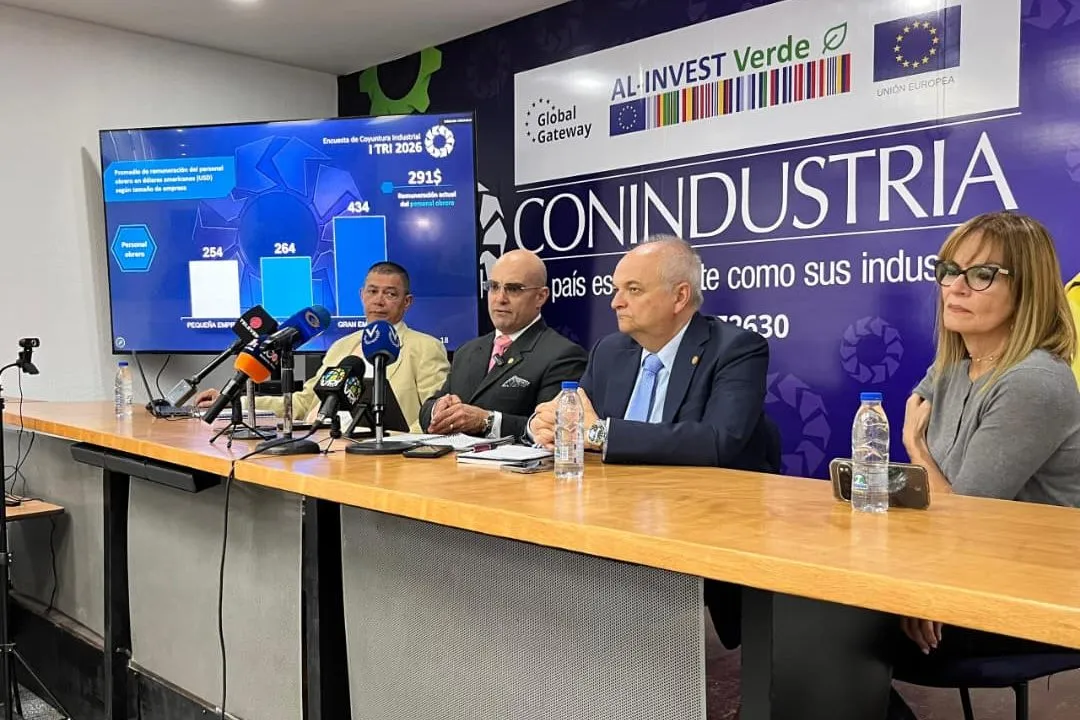
The industrial sector expanded 9.7% between January and September, according to Conindustria. However, power outages, the tax burden, and macroeconomic imbalances remain among the main obstacles to production.
The Daily Journal.- Venezuela’s private manufacturing sector recorded 12.8% year-over-year growth in production volume during the third quarter of 2026, compared with the same period a year earlier, according to the results of the Industrial Business Conditions Survey released by the Venezuelan Confederation of Industrialists (Conindustria).
Positive growth rates across all three months supported the sector’s performance: 16.3% in July, 10.1% in August, and 12.4% in September.
With these results, private industry accumulated 9.7% growth between January and September. This expansion follows year-over-year increases of 9.9% in the first quarter and 6.5% in the second, according to the third-quarter 2026 Industrial Business Conditions Survey (ECI-III26).
Conindustria President Tito López attributed the sector’s performance to business owners’ reinvestment efforts and the optimization of internal processes to maintain supplies to the domestic market.
“If, despite all the structural factors currently restricting the economy, Venezuelan industrialists have demonstrated that we can grow by 12.8%, imagine what private industry could achieve and how much it could expand in the short, medium, and long term if we had reliable public services, tax relief, simplified administrative procedures to reduce excessive bureaucracy, and timely access to financing,” he stated.
Restrictions facing the industrial sector
Despite production growth, the manufacturing sector continues to face infrastructure problems, tax pressures, and macroeconomic imbalances that affect operating costs and production capacity.
Power outages emerged as the industry’s main obstacle, with 71% of surveyed companies identifying them as a major concern, compared with 68% in the previous quarter. The problem particularly affects large manufacturers, with 87% reporting disruptions, and small manufacturers, with 62%.
The tax and parafiscal burden ranked second among the sector’s constraints, affecting 68% of companies. However, it remained the primary concern for medium-sized businesses, with 65% of respondents identifying it as their main obstacle.
The macroeconomic environment ranked third, particularly inflation and the depreciation of the bolívar. This factor increased by 18 percentage points compared with the second quarter and affected 64% of manufacturing companies.
The survey warned that the official exchange rate was failing to keep pace with rising prices. According to Conindustria’s figures, accumulated inflation through October reached 246%, while the official exchange rate increased by 198%.
The 48-percentage-point gap, which the organization identifies as an exchange rate lag, favors imports and undermines the competitiveness of domestic production, potentially affecting formal employment.
Restrictions on access to foreign currency and the movement of funds denominated in foreign currencies ranked fourth, affecting 52% of companies. These limitations make it difficult to replenish inventories and purchase imported supplies necessary to maintain operations.
Finally, 44% of industrialists identified the lack of financing as a constraint because it limits working capital and opportunities for technological modernization.
The findings reflect a recovery in private manufacturing activity during the first nine months of 2026, although structural challenges continue to restrict the sector’s production capacity and competitiveness.
With information from a press release