By Óscar Reyes Matute
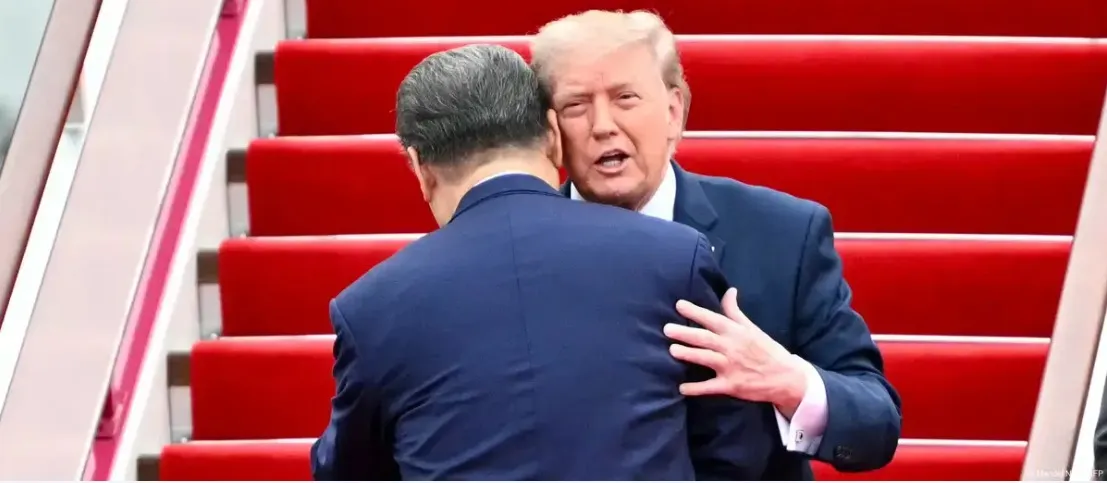
The unprecedented embrace between Xi Jinping and Donald Trump in Beijing, with Vladimir Putin forming the third point of the equation, confirms the return of pure Realpolitik: a concert of superpowers dividing spheres of influence. At the same time, Europe discovers the cost of not having its own seat at the table of global power.
The Dragon’s embrace signals a tectonic shift in global geopolitics: the definitive transition toward a multipolar world dominated by major spheres of influence, where superpowers negotiate directly with one another, bypassing traditional multilateral institutions.
I believe political science and global geopolitics offer several key perspectives through which to interpret this scenario:
Xi’s embrace: Pragmatism and recognition among equals
In Chinese diplomacy, physical gestures are never improvised. An embrace with Trump reflects two underlying dynamics:
Personalized diplomacy: Xi Jinping understands that Trump operates through personal relationships, ego, and direct transactions (“the art of the deal”), rather than through institutions or ideology. By extending an exceptional welcome, Xi defuses Washington’s hostile rhetoric and elevates the relationship to one between mutually respectful “strong leaders.”
The distribution and balance of power: Rather than friendship, the gesture symbolizes a strategic truce. After years of trade and technological warfare, along with tensions in the Indo-Pacific, Beijing and Washington recognize the unsustainable cost of confrontation. The embrace suggests that both powers are willing to define their respective spheres of influence: commercial and technological stability in exchange for geopolitical restraint.
There will be no military war, and the trade war will continue, but these two countries will maintain an understanding. Essentially, that is what they have done so far.
Where does Vladimir Putin stand? The third point of the triangle
Putin is far from a mere bystander. Instead, he serves as the pivotal figure balancing the equation, albeit from an asymmetrical position.
For Washington (Trump): The historic objective of American realist diplomacy (Kissinger-style, but in reverse) is to prevent a monolithic alliance between Russia and China. By engaging with both leaders, Trump seeks to offer Putin a negotiated way out of the prolonged war in Ukraine and Western isolation, in exchange for ensuring that Moscow does not become an exclusive economic and energy satellite of Beijing.
For Beijing (Xi): Russia remains an indispensable strategic partner, providing energy security and a military counterweight to NATO. However, China also benefits from global stabilization that would revive international trade.
For Moscow (Putin): Sitting as an equal alongside Trump and Xi represents his greatest symbolic victory. It confirms the failure of the Western strategy to isolate him. It establishes him as one of the three architects of the emerging world order (at least from a Western perspective), with a direct voice in Eurasian security and global energy markets.
A geopolitical realignment away from Europe and the Middle East?
Rather than abandoning these regions, the major powers are shifting the center of gravity of global decision-making.
The shift toward the Asia-Pacific and Eurasia: The Washington-Beijing-Moscow axis defines the 21st century. Conflicts in Eastern Europe (Ukraine) and the Middle East (Gaza, Iran and Lebanon) cease to function as isolated crises and instead become bargaining chips on a much larger geopolitical chessboard.
If the three powers agree on global rules of engagement, regional wars will lose the geopolitical fuel that keeps them burning.
Where does this leave Europe?
Europe is undoubtedly the major strategic loser in a summit of this nature.
From actor to spectator: If Washington negotiates directly with Moscow and Beijing over global security, trade, and Ukraine’s future, the European Union is relegated to a secondary role, forced to shoulder the economic and reconstruction costs of decisions made without its participation.
The dilemma of “strategic autonomy”: Caught between its military dependence on the United States (NATO) and its commercial dependence on China, Europe risks fragmentation and a loss of influence in a world governed by the uncompromising realism of great-power politics (Realpolitik), where liberal values and European multilateralism lose their ability to shape outcomes.
This summit marks the return of a 19th-century-style concert of great powers, but on a planetary scale: three strong leaders dividing spheres of influence, cooling military conflicts that drain their economies and confronting traditional allies — particularly Europeans — with the stark reality that only those who possess hard power can claim a seat at the table where global decisions take shape.